
Contract Manufacturing for Injection Molded Plastic Products in North America
(800) 824.0607
Choosing the 2026 best SMC compression molding press requires more than comparing tonnage and purchase prices. Global buyers need equipment that matches material behavior, production volume, mold dimensions, and regional operating conditions. A reliable press should provide stable pressure control, accurate platen parallelism, repeatable heating, and accessible maintenance points. These features directly influence surface finish, fiber distribution, cycle time, and long-term operating costs.
The Smc Slice Material Press deserves careful attention when manufacturers process pre-cut SMC charges for automotive panels, electrical enclosures, construction components, or industrial covers. In a working factory, operators may handle warm molds, heavy charge pieces, and strict production schedules. Hydraulic response, temperature uniformity, safety guarding, and controller usability therefore matter as much as rated force. Small errors become expensive quickly. A press that loses pressure during curing can create warped edges, voids, or inconsistent thickness.
Global sourcing adds another layer of evaluation. Buyers should review installation support, spare-parts availability, electrical compatibility, training, and documented quality procedures. Supplier experience should be supported by test reports, reference projects, and transparent acceptance criteria. Certifications are useful, but they do not replace practical verification. Ask for sample molding results.
Some specifications look impressive but remain incomplete without production evidence. This is where careful buyers should pause. A machine may perform well in demonstrations yet require stronger process control in continuous operation. The best choice is not always the largest press. It is the press that delivers dependable results, measurable energy efficiency, and manageable service requirements across its expected working life.
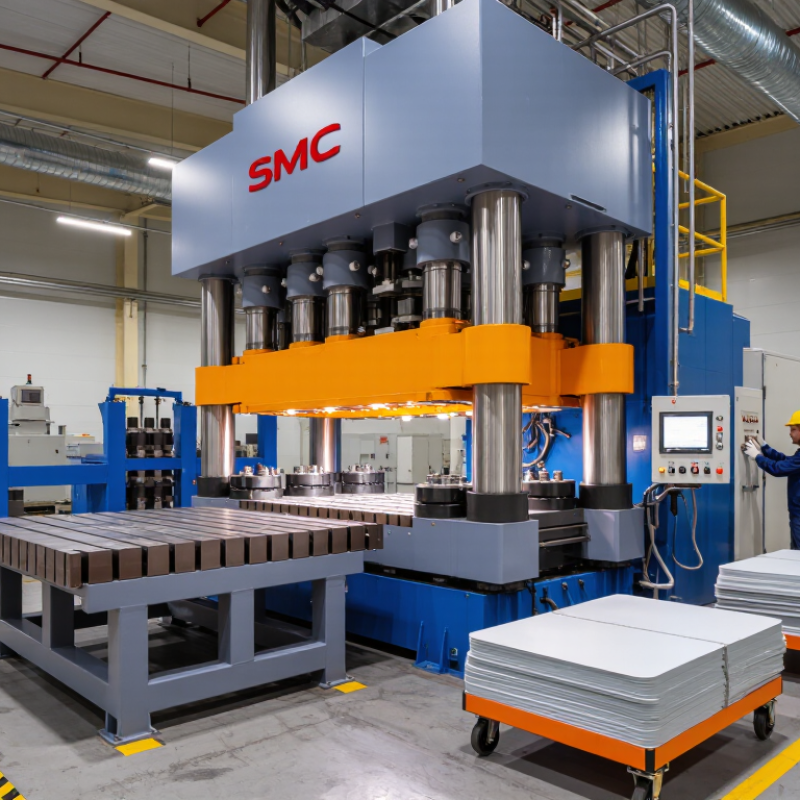
An SMC compression molding press forms heated sheet molding compound into rigid composite parts. SMC usually contains resin, chopped glass fibers, mineral fillers, pigments, and curing additives. The material is placed inside a matched metal mold. Heated platens then apply controlled pressure until the compound fills the cavity and cures.
A typical press includes a hydraulic power unit, steel platens, a mold-clamping structure, and temperature controls. Some systems use automated loading and unloading equipment. During production, operators monitor mold temperature, closing speed, pressure, and curing time. These details affect surface finish, fiber distribution, dimensional stability, and cycle efficiency. A dashboard may show pressure changes within seconds. Small variations can create visible sink marks or incomplete edges.
For global buyers, press capacity should match the projected part size and material flow. A larger machine is not automatically better. Excess capacity can increase energy use and installation costs. In practice, mold design often limits performance more than press strength. That assumption can fail. Experienced engineers test the actual SMC grade with the intended mold before confirming production settings. They also inspect platen parallelism, safety systems, spare-part access, and operator training. A reliable press should deliver repeatable force and temperature, not merely impressive specifications. Human judgment still matters.
2026 Best SMC Compression Molding Press for Global Buyers?
How SMC Compression Molding Presses Work
An SMC compression molding press shapes pre-cut sheet molding compound under controlled heat and pressure. Operators place the charge inside a heated mold cavity. The upper platen then closes, compressing the material across the tool surface. Heat softens the resin, while pressure pushes glass fibers and compound into ribs, corners, and mounting points. The resin cures during the dwell period. Then, the mold opens, and the finished part is removed for trimming and inspection.
The process looks simple. It is not always forgiving. Uneven charge placement can create weak zones, air pockets, or visible flow marks. A stable hydraulic system, accurate platen parallelism, and responsive temperature control matter greatly. Practical buyers should check pressure repeatability, daylight opening, mold size, cycle records, and service access. A press with impressive force may still perform poorly if its heating zones respond slowly. That detail is easy to miss.
Tips: Keep the SMC charge clean and consistent. Record mold temperature at several points, not only on the controller. Start with conservative pressure and dwell settings, then adjust after inspecting thickness, fiber distribution, and surface quality. Check flash around the mold edge. Excess flash often signals poor charge sizing, excessive pressure, or worn tooling. Maintenance teams should also inspect seals, heaters, sensors, and hydraulic oil regularly. Small drift becomes expensive scrap.
SMC compression molding typically uses heated molds at approximately 140–160°C and molding pressures around 5–15 MPa. The charge is placed into the lower mold, compressed under controlled force, cured, and then released. The values shown are representative industrial reference points; actual settings depend on material formulation, part geometry, thickness, and tooling design.
Global buyers should compare more than nominal tonnage. A 1,000-ton press may suit medium SMC panels, but mold area, daylight, and material flow decide real output. Typical SMC molding operates near 140–170°C and 50–150 bar, depending on resin, thickness, and reinforcement. Ask for platen temperature uniformity, preferably within ±3°C across the working area. Also verify pressure stability, closing speed, ejector stroke, and parallelism under load. Small errors can create uneven thickness, visible waviness, or trapped air.
Market context matters. Grand View Research reported continued growth in the global composites market, supported by transportation, electrical, and construction demand. The International Energy Agency’s Global EV Outlook 2024 recorded nearly 14 million electric car sales in 2023, increasing pressure for lighter structural components. These trends make cycle time important. Compare complete cycles, not only hydraulic closing speed. A practical target may include consistent heating, controlled decompression, and automatic mold handling. Energy consumption per molded part also deserves attention.
Request factory acceptance data with the actual mold or a comparable tool. Check platen deflection, oil temperature, control-system records, and emergency functions. Confirm electrical standards, spare-part availability, and remote service coverage for your region. I would not select the largest press automatically. Oversized equipment can increase installation cost and idle energy use. Yet this judgment can fail when future molds are underestimated. Leave usable daylight and force capacity for expansion, not guesswork.
2026 Best SMC Compression Molding Press for Global Buyers?
The best press configuration depends on the SMC component, not only its required tonnage. For large automotive panels, a four-post hydraulic press offers balanced force across wide molds. It also supports stable platen movement and easier mold access. Smaller electrical housings may need a compact H-frame press with precise pressure control. Heated platens should maintain even temperature across the mold surface. Uneven heating can create warpage, resin-rich areas, or inconsistent surface quality.
For deep ribs and complex shapes, consider a press with programmable pressure stages and controlled closing speed. Vacuum assistance can help reduce trapped air during molding. A suitable charge-positioning method also matters. It improves material flow and reduces unnecessary trimming. I have seen projects focus heavily on peak force while overlooking daylight, mold thickness, and ejection stroke. That decision can limit production later. No configuration fits every SMC application.
Tips: Compare platen flatness, heating uniformity, cycle data, and safety controls. Ask for test-molding evidence using a similar SMC grade. Check whether the control system records pressure, temperature, and closing position. Plan for maintenance access. A press may perform well initially, yet difficult access can increase downtime. Also, leave reasonable capacity for future molds. Oversizing is costly, but selecting the absolute minimum can be a bigger mistake.
| SMC Application | Typical Part Characteristics | Recommended Press Capacity | Recommended Press Configuration | Key Technical Requirements | Suitable Automation Level | Selection Considerations for Global Buyers |
|---|---|---|---|---|---|---|
| Automotive Exterior Panels | Large panels, visible surfaces, moderate-to-complex contours, Class-A appearance requirements | 1,000–2,500 metric tons | Four-column hydraulic press with a large daylight opening and rigid moving platen | High platen parallelism, controlled closing speed, multi-zone mold temperature control, precise pressure holding | High automation with material loading, mold handling, trimming, and part unloading | Prioritize platen stiffness, repeatability, mold protection, and a work area suitable for the largest projected part. |
| Automotive Underbody Shields | Medium-to-large structural covers, ribs, mounting bosses, and relatively complex geometry | 800–1,800 metric tons | Hydraulic compression press with programmable pressure and speed profiles | Fast approach stroke, stable low-speed closing, adequate ejection force, robust mold protection | Medium to high automation | Select sufficient daylight and stroke for deep ribs; account for inserts, cooling channels, and post-mold trimming. |
| Electrical Enclosures | Flat or box-shaped housings, mounting features, controlled wall thickness, insulation performance | 300–1,000 metric tons | Four-column or straight-side hydraulic press with accurate position control | Stable pressure control, uniform mold temperature, reliable venting, controlled cure cycle | Medium automation with recipe-based production control | Check platen dimensions, mold-change access, and compatibility with required electrical safety standards. |
| Electrical Meter and Distribution Boxes | Small-to-medium housings, repeatable dimensions, multiple cavities, fire-retardant compounds | 200–800 metric tons | Compact hydraulic press with multi-cavity mold support | Accurate ram positioning, consistent dwell time, low pressure fluctuation, efficient mold heating | Medium to high automation | A multi-cavity layout can improve output, but mold balance and uniform filling must be verified during trials. |
| HVAC and Ventilation Components | Large covers, ducts, fan housings, and panels with dimensional stability requirements | 500–1,500 metric tons | Large-bed hydraulic press with extended daylight and adjustable pressure profiles | Large mold area, uniform platen heating, adequate stroke, controlled cure and cooling stages | Medium automation | Evaluate the complete mold envelope, including hot-runner-free feed systems, lifting points, and maintenance clearance. |
| Renewable Energy Electrical Housings | Weather-resistant housings, covers, junction boxes, and structural support components | 400–1,200 metric tons | Energy-efficient hydraulic press with programmable cycle management | Consistent clamp force, corrosion-resistant ancillary equipment, reliable temperature monitoring | Medium automation with traceability functions | For export projects, confirm voltage, safety guarding, hydraulic standards, documentation, and remote service capability. |
| Railway Interior and Exterior Parts | Large panels, seat components, equipment covers, and low-smoke or flame-retardant parts | 800–2,000 metric tons | Heavy-duty four-column press with reinforced platen and high mold-load capacity | High structural rigidity, repeatable cure control, generous daylight, robust safety interlocks | High automation for repeat production | The compound, mold, and process should be validated against the applicable railway fire, smoke, and toxicity requirements. |
| Battery and Energy-Storage Covers | Flat or ribbed covers, dimensional sealing surfaces, fire-resistant and electrically insulating parts | 500–1,500 metric tons | Precision hydraulic press with high platen parallelism and controlled pressure ramp | Accurate force measurement, stable temperature uniformity, mold safety monitoring, repeatable cycle data | High automation with inspection and traceability | Consider insert loading, sealing-surface tolerances, nonconductive tooling requirements, and process-data storage. |
| Sanitary and Water-Treatment Components | Pump covers, access panels, inspection covers, and corrosion-resistant molded parts | 300–1,000 metric tons | Hydraulic press with adjustable pressure, programmable dwell, and easy mold access | Good surface finish control, uniform heating, effective venting, simple cleaning access | Low to medium automation | Specify surface-quality targets, dimensional tolerances, chemical-resistance requirements, and insert-molding needs. |
| Industrial Machine Covers | Medium-to-large protective guards, housings, doors, and impact-resistant covers | 400–1,200 metric tons | Flexible four-column hydraulic press suitable for varied mold sizes | Wide operating window, quick mold change, adjustable stroke, reliable overload protection | Low to medium automation | A versatile press is often preferable when production includes multiple part families and frequent tooling changes. |
Selecting a reliable SMC compression molding press supplier in 2026 requires more than comparing prices. Buyers should examine press capacity, platen parallelism, heating control, cycle repeatability, and energy consumption. Ask for measured performance data, not only catalog claims. A dependable supplier can explain how its press handles glass fiber content, mold weight, and production temperature changes.
Visit the supplier’s factory when possible. Observe machining quality, hydraulic cleanliness, electrical cabinet assembly, and final testing procedures. Request a factory acceptance test using your own mold or a similar production sample. Check whether the supplier follows recognized safety and quality systems, provides traceable components, and documents pressure, temperature, and cycle results. Customer references from comparable industries are especially valuable. One successful installation proves little.
After-sales support often separates a useful supplier from a risky one. Confirm response times, spare-part availability, remote diagnostics, installation training, and technician coverage in your region. Clarify warranty exclusions before signing. A low quotation may become expensive when commissioning is slow or replacement seals are unavailable. I have also seen polished documentation hide weak process control, so buyers should verify every important claim. No supplier is perfect. Ask how it records failures, corrects design mistakes, and updates software. That answer may reveal more than a showroom tour.