
Top Electric Lawn Riding Mowers for Global Buyers
Choosing the right Electric Lawn Riding Mower is more complicated than comparing battery size and cutting width. Global buyers face different lawns, climates, voltage systems, service networks, and transport conditions. A machine that performs well on a flat suburban yard may struggle on wet grass, steep slopes, or rough ground.
Kris Kiser, president and CEO of the Outdoor Power Equipment Institute, has said, “Battery-powered outdoor power equipment is here to stay.” His view reflects a clear industry shift. Yet electric does not automatically mean better for every property. Buyers should examine deck strength, battery charging time, hill control, turning radius, noise levels, and replacement-part availability. These details matter when the nearest dealer is hundreds of kilometers away.
Performance must be practical.
This guide compares leading riding mowers through an international buyer’s lens. It considers cutting consistency, operator comfort, battery endurance, charging flexibility, warranty support, and long-term maintenance. Real-world conditions also matter: a dusty field, a narrow garden gate, or grass growing quickly after heavy rain can expose weaknesses that showroom demonstrations hide.
No ranking is universally right. That deserves attention. Some models offer impressive runtime but limited repair access. Others feel powerful yet remain expensive after shipping, taxes, and battery replacement. By examining strengths, compromises, and overlooked ownership costs, this overview aims to help buyers choose with clearer expectations—not simply follow the loudest marketing claim.
What Defines an Electric Riding Lawn Mower
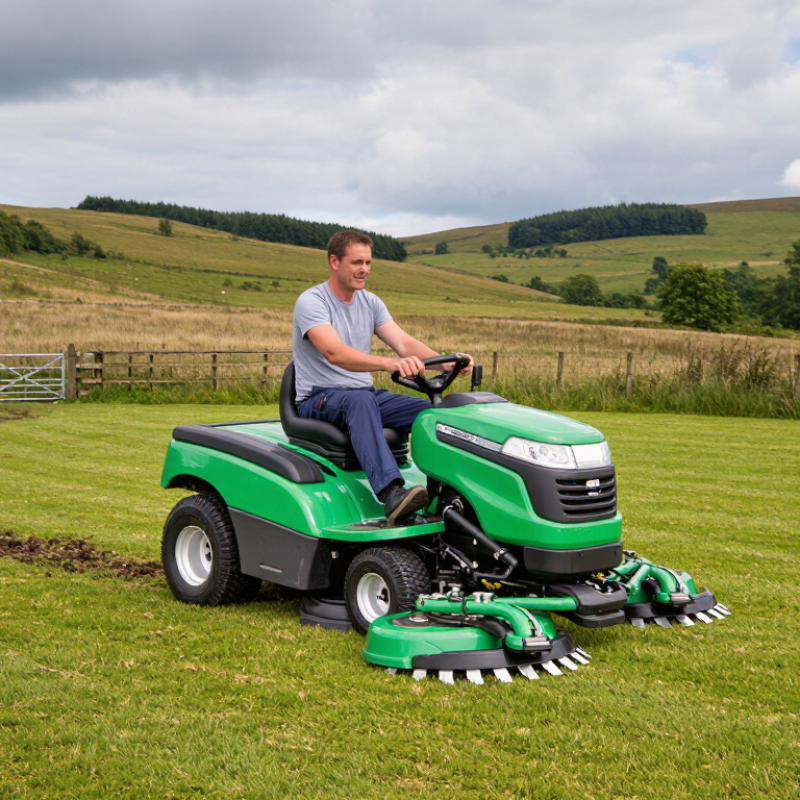
An electric riding lawn mower is more than a small tractor with a battery. It combines a seated chassis, cutting deck, traction motor, onboard charger, and rechargeable energy system. The battery usually uses lithium-ion cells, while electric motors deliver instant torque at low speed. That matters when climbing damp slopes or carrying a full grass catcher.
The defining measure is usable work, not advertised voltage. Fortune Business Insights estimated the global electric lawn mower market at about USD 9.39 billion in 2023, with continued growth through 2030. However, riding models consume more energy than walk-behind machines. A 48-volt, 100-ampere-hour battery stores roughly 4.8 kilowatt-hours before efficiency losses. Thick grass, hills, wet soil, and frequent deck engagement can reduce mowing time sharply. Runtime claims need real conditions.
Quiet operation is another practical feature. The U.S. Department of Energy identifies electric motors as highly efficient because they convert more input energy directly into movement. Less vibration can also improve comfort during long sessions. Safety still depends on strong brakes, stable steering, blade control, and charging protection. ISO 5395 provides widely recognized safety requirements for powered lawnmowers, although buyers should check local certification rules. I would not judge a mower by battery size alone. That shortcut feels convenient, but it can hide weak hill performance, slow charging, or an undersized deck. A better evaluation includes terrain, cutting width, service access, and winter battery storage.
Top Electric Lawn Riding Mowers for Global Buyers - What Defines an Electric Riding Lawn Mower
| Evaluation Dimension | Compact Electric Rider | Electric Lawn Tractor | Electric Zero-Turn Mower | What Global Buyers Should Check |
|---|---|---|---|---|
| Typical cutting width | 30–38 in (76–97 cm) | 38–54 in (97–137 cm) | 42–60 in (107–152 cm) | A wider deck reduces mowing passes but needs more storage space and clearance. |
| Recommended lawn size | Up to about 0.5 acre (0.2 ha) | About 0.5–2 acres (0.2–0.8 ha) | About 1–5 acres (0.4–2 ha), depending on terrain | Actual coverage depends on grass density, slope, cutting height, deck size, and operator technique. |
| Battery system | Usually 36–48 V lithium-ion | Usually 48–72 V lithium-ion | Usually 48–72 V lithium-ion; larger packs are common | Compare total battery energy in watt-hours or kilowatt-hours, not voltage alone. |
| Approximate battery capacity | About 1.5–3 kWh | About 3–8 kWh | About 4–12 kWh | Usable energy is lower than the nominal rating because battery-management systems reserve a safety margin. |
| Typical mowing runtime | Approximately 45–90 minutes | Approximately 60–150 minutes | Approximately 60–180 minutes | Runtime estimates are normally based on moderate conditions and may fall in tall, wet, or dense grass. |
| Charging time | About 4–8 hours with a standard charger | About 4–10 hours; rapid charging may reduce this | About 4–12 hours, depending on battery size and charger output | Confirm charging voltage, plug type, socket requirements, and compatibility with the local electrical system. |
| Maximum forward speed | Approximately 4–5 mph (6–8 km/h) | Approximately 4–6 mph (6–10 km/h) | Approximately 6–8 mph (10–13 km/h) | Higher transport speed does not necessarily mean faster mowing on irregular or obstacle-filled lawns. |
| Turning capability | Tight turning radius, but not usually zero-turn | Typically wider turning radius | Zero-turn capability; highly maneuverable around trees and beds | Zero-turn steering is efficient on open ground but requires practice near slopes, edges, and obstacles. |
| Cutting-height range | Typically 1.5–4 in (3.8–10 cm) | Typically 1–4.5 in (2.5–11.4 cm) | Typically 1–5 in (2.5–12.7 cm) | A height adjustment system with multiple locked positions improves consistency across different grass types. |
| Deck and blade configuration | Single blade is common; twin-blade designs also exist | Two or three blades are common | Two or three blades are common | Stamped steel decks are lighter; fabricated decks are generally more rigid and durable but heavier. |
| Drive system | Single electric transaxle or rear-wheel drive | Electric transaxle with rear-wheel drive | Two independent electric wheel motors are common | Independent motors improve maneuverability but can increase control-system complexity. |
| Noise profile | Low mechanical noise; blade noise remains | Low mechanical noise; suitable for noise-sensitive areas | Low mechanical noise; larger decks may produce more airflow noise | Electric models eliminate engine exhaust noise but are not silent during blade operation. |
| Routine maintenance | Blade sharpening, deck cleaning, tire checks, and battery care | Same tasks plus drive-system and deck-belt inspection where applicable | Blade, deck, tire, motor, and steering-control inspections | Electric drivetrains generally remove oil changes, spark plugs, fuel filters, and exhaust-system servicing. |
| Best operating environment | Small, maintained lawns with narrow access paths | Mixed residential lawns with moderate open areas | Large, open lawns where fast turning and high productivity matter | Measure gates, sheds, ramps, and storage doors before selecting deck width. |
| Slope considerations | Best on relatively flat or gently sloped ground | Suitable slope varies by model, tire grip, and surface condition | Designed mainly for stable, open terrain; steering can be difficult on side slopes | Always follow the model-specific slope limit and avoid wet grass, sudden turns, and unsupported operating conditions. |
| Core buying priority | Compact size, simple controls, and easy storage | Balanced cutting capacity, comfort, and versatility | High productivity, maneuverability, and large battery capacity | The best choice is determined by lawn area, terrain, charging access, local service support, and replacement-battery availability. |
Data note: The figures shown are representative ranges for current electric riding-mower categories, not specifications for a particular company or brand. Actual performance varies with battery capacity, grass conditions, ambient temperature, terrain, cutting height, and operator settings.