
How to Choose the Best Ice Bath Pods for Global Buyers
Choosing the right Ice Bath Pods requires more than comparing prices or attractive product photos. Global buyers must examine insulation, liner strength, drainage design, water capacity, and temperature performance. A pod may look durable online but feel unstable after repeated use. That matters.
Real-world experience often reveals details that specifications miss. Check whether the pod remains firm on uneven ground. Inspect the cover, seams, valves, and carrying handles. Ask suppliers for material information, independent test reports, and clear warranty terms. Reliable manufacturers should explain cleaning requirements and recommended water treatment. Their answers should be specific, not vague.
International purchasing adds practical concerns. Shipping dimensions, import duties, replacement parts, and regional electrical requirements can affect the final cost. Choose designs that are easy to assemble and maintain locally. For frequent use, reinforced insulation and a secure cover may offer better value than a cheaper, thinner model. Still, there is no universal best option. A compact pod may suit a small apartment, while an insulated outdoor model may fit a professional training facility. My own judgment would remain cautious when brands promise extreme durability without evidence. Marketing language can sound convincing. Product testing and customer feedback are stronger guides. This guide helps buyers compare Ice Bath Pods with a clearer, safer, and more realistic purchasing approach.
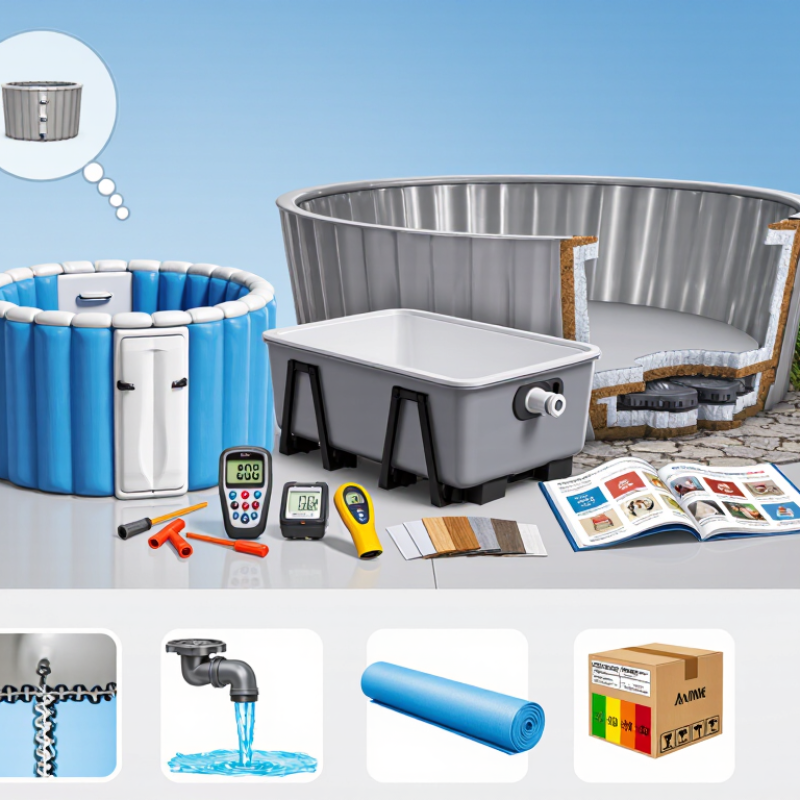
Define Ice Bath Pod Types and Their 10–15°C Operating Requirements
Global buyers should define an ice bath pod by its cooling method, not its appearance. Common types include insulated static tubs, portable foldable pods, and recirculating systems with active chillers. Static tubs depend on added ice and ambient conditions. Chiller systems maintain temperature more consistently, but require filtration, drainage, and electrical safety controls. The Global Wellness Institute valued the global wellness economy at $6.3 trillion in 2023, showing strong demand for recovery products, but market growth does not replace technical verification.
For most recovery applications, specify a stable operating range of 10–15°C. A 2021 review in Sports Medicine reported that many cold-water immersion protocols use temperatures within this range. Buyers should request temperature logs, not only product claims. A pod reaching 10°C briefly is different from one holding 12°C after repeated use. Look for a calibrated thermometer, insulated walls, secure covers, and clear water-management instructions. Small details matter. A cold lid helps.
In practice, test the pod at room temperature before purchase. Fill it, measure the water after 30 minutes, and check recovery after entry and exit. Ask how quickly the system returns to its target range. Also confirm cleaning access and replacement-part availability across borders. Some specifications remain vague. That is a warning, though not always a failure. A reflective concern is useful: colder is not automatically better, and user tolerance, supervision, and medical conditions can change the appropriate setup.
| Ice Bath Pod Type | Typical Water Capacity | Cooling Method | Suitable Operating Range | Temperature Control at 10–15°C | Typical Cooling Time* | Recommended Filtration | Insulation Requirement | Portability | Best Use Case | Key Buying Considerations |
|---|---|---|---|---|---|---|---|---|---|---|
| Insulated Inflatable Pod | 250–450 L | Ice or chilled water added manually | Approximately 5–20°C, depending on ice quantity and ambient conditions | Manual adjustment; temperature normally changes gradually and is not automatically maintained | 20–60 minutes when ice is added; varies with starting water temperature | Removable mesh filter or drain-screen filter | Double-wall air insulation with a thermal cover; ground insulation is recommended | High | Home users, travel, temporary outdoor use, and entry-level recovery routines | Check puncture resistance, valve quality, cover fit, drain position, and packed size |
| Rigid Portable Pod | 300–550 L | Ice, chilled water, or optional external cooling unit | Approximately 5–20°C | Better thermal stability than inflatable models; optional chiller may maintain a setpoint near 10–15°C | 15–45 minutes with ice; external chiller performance depends on cooling capacity | Inline or removable cartridge filter, commonly paired with a circulation pump | Foam-lined or molded insulated walls with an insulated lid | Medium | Residential users who want improved durability and moderate mobility | Evaluate wall construction, UV resistance, carrying handles, drainage height, and replacement parts |
| Pod with External Chiller | 350–650 L | Recirculating water chiller with pump and heat exchanger | Typically 3–20°C; 10–15°C is a practical daily-use range | Digital thermostat; a stable system should generally hold within about ±1–2°C after stabilization | Approximately 2–8 hours from 20–25°C water, depending on chiller output, insulation, and room temperature | Mechanical pre-filter plus replaceable cartridge filter; circulation is required | Insulated pod walls and a fitted thermal cover are strongly recommended | Medium | Frequent home use, fitness facilities, and users seeking repeatable temperatures | Confirm cooling output, flow rate, refrigerant compliance, noise level, voltage, and drainage method |
| Integrated Chiller Pod | 400–700 L | Built-in refrigeration system with integrated circulation | Typically 3–18°C, with programmable operation around 10–15°C | Automatic thermostat, display, timer, and safety shutoff; temperature stability depends on sensor placement and water flow | Approximately 2–6 hours from 20–25°C water under moderate ambient conditions | Integrated circulation filter, pump strainer, and accessible filter housing | High-density insulated shell, sealed plumbing, and insulated cover | Low to Medium | Premium residential installations, studios, clinics, and small commercial spaces | Check electrical protection, service access, operating noise, compressor ventilation, and warranty support |
| Compact Indoor Recovery Tub | 180–350 L | External chiller or ice-based cooling | Approximately 5–20°C | Usually suitable for 10–15°C when paired with a thermostat-controlled chiller and adequate circulation | Approximately 1.5–5 hours with a correctly sized chiller | Fine particle filter with continuous or scheduled circulation | Rigid insulated shell and sealed cover; floor protection is important indoors | Medium | Apartments, compact gyms, physiotherapy rooms, and indoor recovery areas | Measure doorways and floor space; verify load capacity, splash control, electrical outlet access, and drainage |
| Commercial Recirculating Pod | 600–1,200 L | Higher-capacity refrigeration, pump, and heat exchanger | Typically 4–20°C, with frequent operation at 10–15°C | Programmable control with continuous circulation; commercial systems should maintain a consistent setpoint under repeated use | Approximately 3–10 hours from 20–25°C water, depending on water volume and cooling capacity | Multi-stage filtration, pump strainer, water-level protection, and scheduled sanitation | Commercial-grade insulated panels and a durable thermal cover | Low | Gyms, sports clubs, hotels, wellness centers, and shared-use facilities | Assess duty cycle, sanitation procedures, service access, drainage, water treatment, and local electrical standards |
| Outdoor All-Season Pod | 400–900 L | Insulated enclosure with external or integrated chiller | Approximately 5–20°C, subject to weather and equipment limits | Automatic control is recommended; 10–15°C operation requires protection from direct sun, wind, and extreme ambient temperatures | Approximately 3–12 hours from 20–25°C water | Continuous circulation with a replaceable filter and debris pre-screen | Weather-resistant insulated shell, fitted cover, protected pipework, and freeze protection where required | Low to Medium | Outdoor homes, hospitality properties, training facilities, and seasonal installations | Verify IP protection, drainage, frost precautions, sunlight exposure, ventilation, and regional climate suitability |