
Contract Manufacturing for Injection Molded Plastic Products in North America
(800) 824.0607
Choosing the best Smart Street Light in 2026 means looking beyond the fixture’s headline brightness. A streetlight must help people see sidewalks, crossings, and road edges without creating harsh glare. It should also dim reliably when streets grow quiet. Small details matter.
Mark Rea, a lighting researcher and former director of the Lighting Research Center, offers a useful principle: judge lighting by visual performance, not brightness alone. This is a paraphrase of the approach reflected in his research, not a direct quotation. It matters when comparing products that advertise high lumen output but provide little information about light distribution, controls, or maintenance.
This guide examines the practical differences between leading smart street-light systems. It considers LED efficiency, adaptive dimming, sensors, network connectivity, cybersecurity practices, and compatibility with existing infrastructure. It also looks at warranty terms and how easily crews can replace components from a bucket truck. A well-lit intersection can still have dark patches. Specifications do not always reveal them.
There is no single fixture that suits every street. A coastal road, a residential lane, and a busy junction have different needs. The best choice depends on local conditions, measured performance, and long-term operating costs—not a product’s marketing label. Even careful comparisons have limits; real-world trials can reveal issues that a datasheet misses.
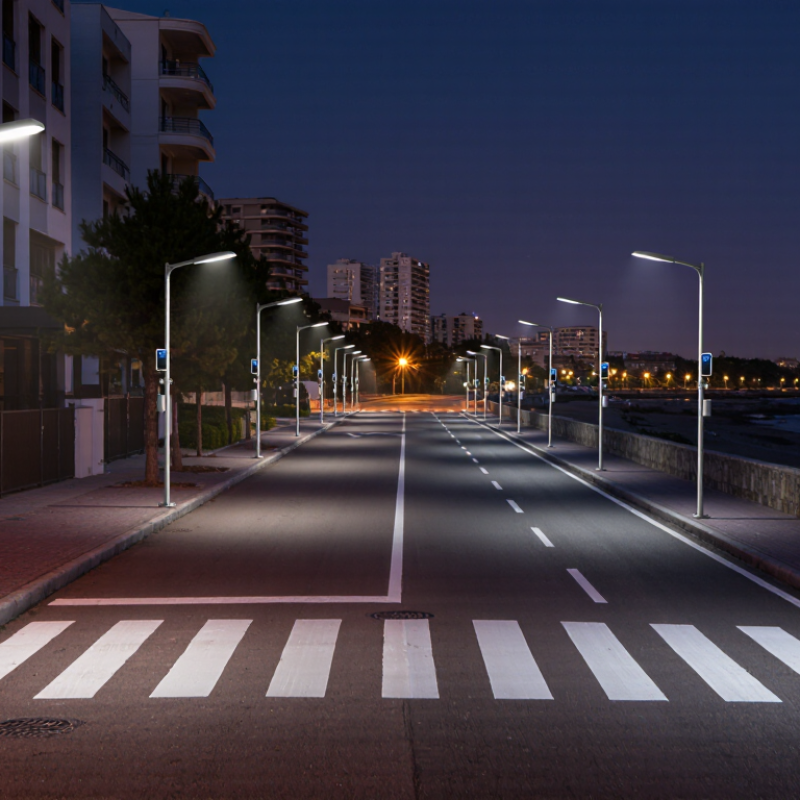
A smart street light is more than an LED lamp on a pole. It combines efficient lighting with remote controls, network communication, and useful operating data. Operators can dim lamps at quiet hours, raise output when pedestrians or vehicles approach, and receive outage alerts without driving street by street. That distinction matters. A connected lamp is not automatically smart.
The International Energy Agency reports that lighting accounts for about 15% of global electricity use and roughly 5% of greenhouse-gas emissions. The U.S. Department of Energy says LED streetlights can use at least 50% less energy than conventional streetlights. These figures describe lighting efficiency, not guaranteed savings from smart controls. Actual results depend on schedules, local conditions, and whether dimming is properly commissioned.
A practical system also needs reliable sensors, secure communications, and controls that work with equipment from different suppliers. On a rainy road, for example, a sensor should not leave a crossing dim when people are waiting. Maintenance teams need clear fault reports, not another dashboard full of noise. Still, gaps remain: networks fail, sensors misread scenes, and savings can disappoint. A careful pilot should measure light levels, energy use, and outage response before a city expands the system.
A smart street lighting system combines LED luminaires, sensors, controllers, and management software. At dusk, a light sensor can trigger scheduled operation. The controller then adjusts brightness according to preset rules, rather than leaving every lamp at full output all night. Simple, but useful.
Some systems use motion or radar sensors to detect approaching pedestrians and vehicles. A nearby lamp may brighten, while connected lights ahead respond in sequence. Controllers send operating data through a mesh network or cellular connection to a central platform. Staff can check energy use, identify outages, and sometimes receive alerts when a driver or power component fails.
The details matter. A poorly placed sensor may react to tree movement, while an overly aggressive dimming schedule can leave a sidewalk uncomfortable to use. Settings should account for road layout, weather, traffic patterns, and the needs of people walking or cycling. Field testing helps reveal problems that a control-room dashboard cannot. It is not perfect.
Reliable systems also need secure communications, clear maintenance procedures, and sensible data limits. For example, lighting sensors can measure movement without recording identifiable images. Network coverage may vary from one block to the next, so local controls should still keep lights operating if a connection drops. Smart lighting is not just a lamp with an app; it is a coordinated system that needs careful setup and regular review.
The best smart street light in 2026 is not simply the brightest one.
It should dim smoothly, report faults, and work with open communication protocols. A midnight street needs less light than a busy junction at 7 p.m. Good adaptive controls respond to schedules or measured activity, while keeping light levels consistent and avoiding abrupt dark patches. That matters. The U.S. Department of Energy’s Municipal Solid-State Street Lighting Consortium guidance highlights controls, commissioning, and careful system planning as part of successful street-lighting projects. Buyers should ask how sensors are calibrated, how outages are reported, and whether staff can export operating data without relying on one supplier.
Efficiency is important, but the savings depend on how a city uses its lights.
The International Energy Agency estimates that lighting accounts for about 15% of global electricity consumption, making efficient operation a meaningful target. DOE guidance also notes that LED street lighting can use substantially less energy than traditional technologies; actual results vary with existing equipment and operating hours. Look for adjustable dimming, remote diagnostics, secure software updates, and clear energy reports. Not just brightness.
A practical field check should include a wet road, a tree-lined sidewalk, and a crossing at night. Sensors can misread motion, and dashboards can hide poor illumination. That is an inconvenient truth. Test performance on the street before scaling up.
A smart street light is not one product type. Cities usually compare photocell-controlled LEDs, scheduled dimming, and networked adaptive systems. The International Energy Agency’s 2023 lighting overview estimates lighting uses about 15% of global electricity. That makes efficiency important, but savings depend on the road, operating hours, and baseline equipment.
Photocells switch lights on at dusk and off at dawn. They are simple, but cannot respond to changing traffic. Scheduled dimming lowers output during quiet hours; it is often a practical middle ground. The U.S. Department of Energy’s 2017 roadway-lighting assessment found LED conversions could cut energy use substantially compared with older roadway fixtures. That figure describes LED upgrades, not a guaranteed extra saving from smart controls. Keep that distinction clear.
Networked systems add remote monitoring, fault alerts, and finer dimming schedules. Sensor-driven controls can react to pedestrians or vehicles, but require careful placement and commissioning. A dark stretch may look efficient on a dashboard while feeling uncomfortable on the sidewalk. The trade-off is real. Compare total operating cost, interoperability, maintenance access, and measured light levels—not just lamp wattage. Ask for a pilot with before-and-after energy data, outage records, and nighttime field checks. Data can still miss local context.
How common street-light control solutions compare by built-in capabilities
How to read this: Scores show typical capability presence: 0 = not inherent to a basic setup, 1 = limited or configuration-dependent, 2 = a typical core capability. These are qualitative comparisons, not measured performance; features vary by system and configuration. Networked controls generally offer the broadest remote management, while sensor-enabled systems can add demand-responsive dimming.
The best smart street light in 2026 depends on what a city needs each street to do. A busy road may need steady illumination and fast fault alerts, while a quiet residential lane may benefit from dimming when no one is nearby. Match the system to traffic patterns, pedestrian activity, existing poles, and local maintenance capacity. More features do not automatically mean better results.
Check how sensors respond to rain, tree movement, and passing vehicles. Ask how operators set dimming schedules and receive outage reports. A useful control platform should show which light failed, when it failed, and whether a repair resolved the issue. Small details matter. Compatibility with existing equipment can reduce replacement work, but older infrastructure may still limit what a system can deliver.
For parks, sidewalks, and mixed-use districts, consider light distribution as well as energy use. Test whether darker periods still feel safe at crossings and bus stops. A small pilot across different street types can reveal blind spots before a wider installation. Measure energy use, repair time, and resident feedback over several weeks. Results may be uneven. Weather, seasonal traffic, and sensor settings can distort early findings, so the evaluation needs adjustment rather than a quick verdict.