
Contract Manufacturing for Injection Molded Plastic Products in North America
(800) 824.0607
Global sourcing of Circuit Breaker Parts demands more than comparing prices on a supplier spreadsheet. Each component must match the breaker’s voltage, current, interrupting capacity, insulation class, and operating environment. A small mismatch can cause overheating, nuisance tripping, or premature failure. In practical sourcing work, experienced buyers begin with the circuit breaker’s technical drawings and approved specifications. They then confirm dimensions, materials, tolerances, and compatibility with the finished assembly.
Details matter.
A reliable supplier should provide traceable material records, inspection reports, production samples, and clear revision control. Ask how contacts are plated, how springs are tested, and how molded housings resist heat and flame. Verify whether the supplier supports relevant IEC, UL, or regional requirements for the target market. Certification alone is not enough. The production process must also remain consistent after approval. Factory audits, first-article inspections, and batch testing can reveal problems before shipment. Packaging deserves attention too. Moisture, vibration, and careless labeling can damage parts or create costly assembly errors.
The lowest quote may hide weak tooling or unstable quality. That said, even a detailed checklist can miss an important risk. Supplier claims should be checked against samples, test data, and independent technical judgment. Lead time, minimum order quantity, replacement support, and communication quality also influence the real purchasing cost. This guide explains how to compare Circuit Breaker Parts suppliers with a practical, evidence-based approach. It also examines where sourcing decisions can fail, because perfect assumptions rarely survive real production.
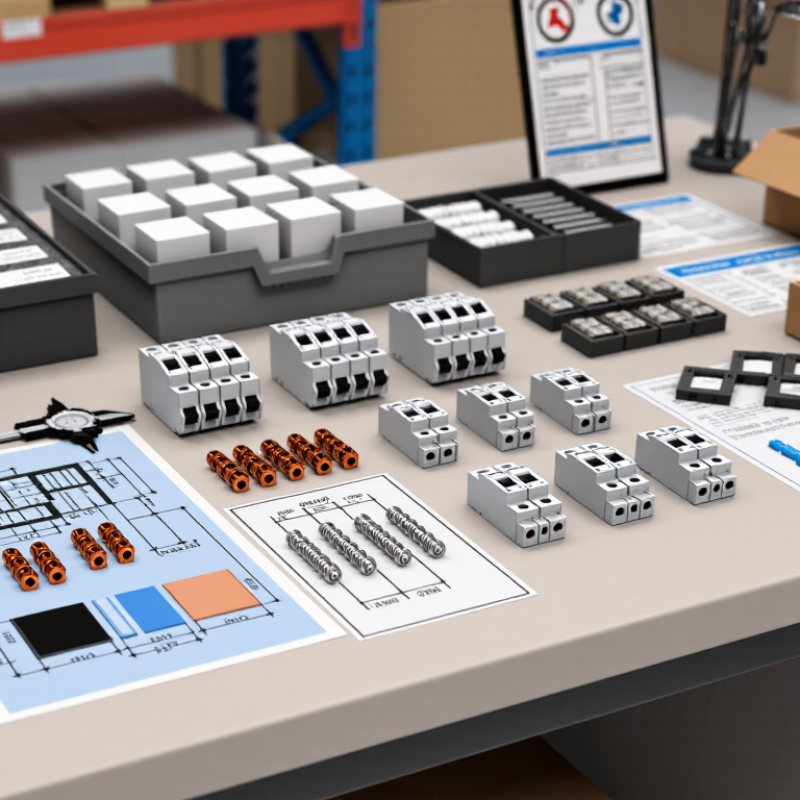
Global sourcing starts with the fault level, not the catalogue price.
Under IEC 60947-2, confirm the circuit breaker’s rated operational voltage, Ue, for the actual system. The standard covers equipment up to 1,000 V AC or 1,500 V DC.
Check insulation voltage, Ui, and impulse withstand voltage, Uimp, when switching environments are harsh. A 400 V system still needs correct insulation coordination.
Rated current, In must match the continuous load after derating. Ambient heat, enclosure size, installation altitude, and nearby devices can reduce usable capacity.
For example, a 100 A breaker may require a lower operating current inside a hot, crowded panel. The label alone is insufficient. Ask for temperature-rise data and verified test conditions.
Breaking capacity needs closer attention.
Icu is the ultimate short-circuit breaking capacity.
Ics measures service breaking capacity after testing.
Both should exceed the prospective short-circuit current at the installation point. Do not confuse Icu with the load current. The difference can be dangerous.
The International Energy Agency’s Electricity 2024 report forecasts global electricity demand growth averaging 3.4% annually through 2026, increasing pressure on distribution equipment and protection coordination.
Request IEC test certificates, short-circuit calculations, and clear terminal specifications from suppliers. One practical weakness remains: imported data may use different network assumptions. Recheck every value against the destination grid.
Selecting circuit breaker parts requires more than matching voltage and current. Start with the load. A motor may need a curve that tolerates starting current without nuisance trips. Sensitive electronic equipment may require faster protection. Common trip curves differ, but their labels alone cannot replace measured application data. Review the actual inrush waveform, operating duty, and expected fault level. I have seen projects fail because a nominally correct breaker tripped during normal motor acceleration.
The I²t rating matters when short-circuit energy reaches downstream components. A lower let-through value can reduce stress on cables, busbars, and semiconductor devices. Compare the breaker’s published I²t data with the protected component’s withstand limit. Do not rely on a catalog headline. Ask for test conditions, tolerance ranges, and interrupting capacity at the required voltage. Small details matter. Also check thermal limits at the real installation temperature. Continuous current can fall sharply inside a warm enclosure, especially with several devices mounted closely.
Global sourcing adds another review layer. Confirm terminal geometry, conductor compatibility, insulation temperature, and certification documents for the target market. Request production samples and inspect trip behavior across several units. One sample proves little. A practical mistake is treating derating tables as optional; I have made that assumption during early selection, and it created avoidable redesign work. Leave margin for altitude, enclosure heating, and manufacturing variation. The cheapest part may become expensive after field testing. Verify the evidence before approving the component.
When sourcing circuit breaker parts globally, certification is not a decorative label. It determines whether a component fits the intended safety system. UL 489 generally applies to molded-case circuit breakers and related overcurrent protection equipment. IEC 60947-2 covers low-voltage circuit breakers under international electrotechnical requirements. Their testing approaches can differ. Do not assume one approval replaces the other.
Request current certificates, complete test reports, and the exact product variant before approving a supplier. Check rated voltage, interrupting capacity, frequency, trip characteristics, insulation distance, and terminal temperatures. A housing may look identical while its internal mechanism carries a different rating. Match every part number to the tested construction. Small changes matter. Confirm whether accessories were included during evaluation.
Regional rules add another layer. Market access may require national marks, local registration, or documents in a specified language. Ask an accredited testing body or qualified compliance engineer to review the destination country. Keep certificates, drawings, batch records, and change notices in one controlled file. My checklist is not flawless. A common sourcing mistake is checking approval after production begins. Sometimes the paperwork seems complete, yet thermal test conditions do not match the real panel. Recheck them.
The chart compares published voltage scope thresholds rather than product ratings. UL 489 covers molded-case and enclosed circuit breakers rated up to 600 V AC. IEC 60947-2 covers low-voltage circuit breakers up to 1,000 V AC or 1,500 V DC. The EU Low Voltage Directive applies to electrical equipment rated from 50 to 1,000 V AC or from 75 to 1,500 V DC. Final sourcing decisions should also verify breaking capacity, current rating, trip characteristics, test reports, marking, and the certification requirements of the destination market.
Global sourcing circuit breaker parts requires more than comparing unit prices. The contact material must match the expected current, voltage, fault level, and switching frequency. Silver-based alloys often support reliable conductivity, while tougher compositions may resist welding under heavy faults. Copper is not automatically the best choice. I have seen specifications fail when engineers ignored heat rise at the terminal. A small mismatch can shorten service life.
Insulation systems deserve the same scrutiny. Check dielectric strength, creepage distance, clearance, temperature class, and resistance to tracking. Polymer parts can perform well, but heat, dust, and repeated arcing change their behavior. Ask for test reports tied to the exact material grade and production process. Generic certificates are weak evidence. Samples should undergo endurance, insulation, and thermal tests before volume orders. This step costs time. It can prevent expensive field returns.
IP protection ratings define resistance to solids and water, not overall product quality. An IP54 enclosure, for example, limits dust entry and water splashes under defined test conditions. It does not guarantee sealing after vibration, gasket aging, or incorrect assembly. Review the installation position, cable glands, drainage path, and maintenance routine. For outdoor panels, test the assembled unit, not only the empty housing. My own procurement reviews often missed this detail. A realistic inspection plan should record batch samples, torque values, and corrective actions. Leave room for doubt. Requirements may change across markets, so verify applicable local standards with a qualified compliance professional.
Global sourcing of circuit breaker parts needs more than a low unit price. The IEA Electricity 2024 report projects global electricity demand growth of about 4% annually through 2026. That pressure makes dependable protection components increasingly important. Ask suppliers for lot-level traceability, not only a factory certificate. Records should connect raw material, molding batch, assembly date, operator, and final inspection results. A clean certificate can still hide weak records.
For 10–65 kA applications, review the actual short-circuit test report. Check the declared test current, voltage, power factor, trip time, arc control, and post-test insulation condition. IEC 60947-2 distinguishes ultimate breaking capacity, Icu, from service breaking capacity, Ics. Both values matter during selection. Confirm whether testing covered the exact pole configuration and accessory combination. Generic graphs are not enough. In audits, missing calibration dates often reveal process gaps.
Tips: Request three recent test records, including one failed or reworked batch. Compare serial numbers with shipment documents. Verify thermal, dielectric, mechanical endurance, and terminal torque checks. ISO 9001 certification supports a quality system, but it does not prove every 65 kA claim. I would also sample incoming parts independently. Supplier promises can be incomplete.