
Contract Manufacturing for Injection Molded Plastic Products in North America
(800) 824.0607

RFQ / CONTACT
Contract Manufacturing for Injection Molded Plastic Products in North America | (800) 824.0607

How to Choose GFRP Bars for Global Construction Projects?

Choosing Gfrp Bars for global construction projects requires more than comparing tensile strength and purchase prices. Engineers must examine durability, design standards, installation conditions, and long-term maintenance needs. A bar that performs well in a dry bridge deck may behave differently near saltwater, freeze-thaw cycles, or high ultraviolet exposure. Details matter.

Professor Antonio Nanni, a recognized authority on fiber-reinforced polymer infrastructure, has stated, “FRP is not a one-to-one replacement for steel.” This principle should guide every selection decision. Gfrp Bars have valuable advantages, including corrosion resistance, low weight, and easier handling. However, they also require careful attention to bond behavior, creep, fire performance, bending limitations, and thermal expansion. Ignoring one factor can weaken an otherwise sound project.

A reliable evaluation begins with verified test data, documented manufacturing controls, and compliance with applicable international or regional standards. Teams should confirm resin chemistry, fiber content, surface treatment, bar dimensions, and batch traceability. They should also review supplier experience in comparable climates and structures. Factory samples are useful, but field conditions can expose problems that laboratory testing misses. That is where the process becomes less certain.

A practical specification should connect structural calculations with real installation details. Consider cutting tools, storage racks, lifting methods, lap lengths, and worker training. Cost matters, but replacement risk matters more. A perfect checklist does not exist. Still, disciplined comparison helps project owners choose Gfrp Bars that remain dependable beyond the construction schedule.
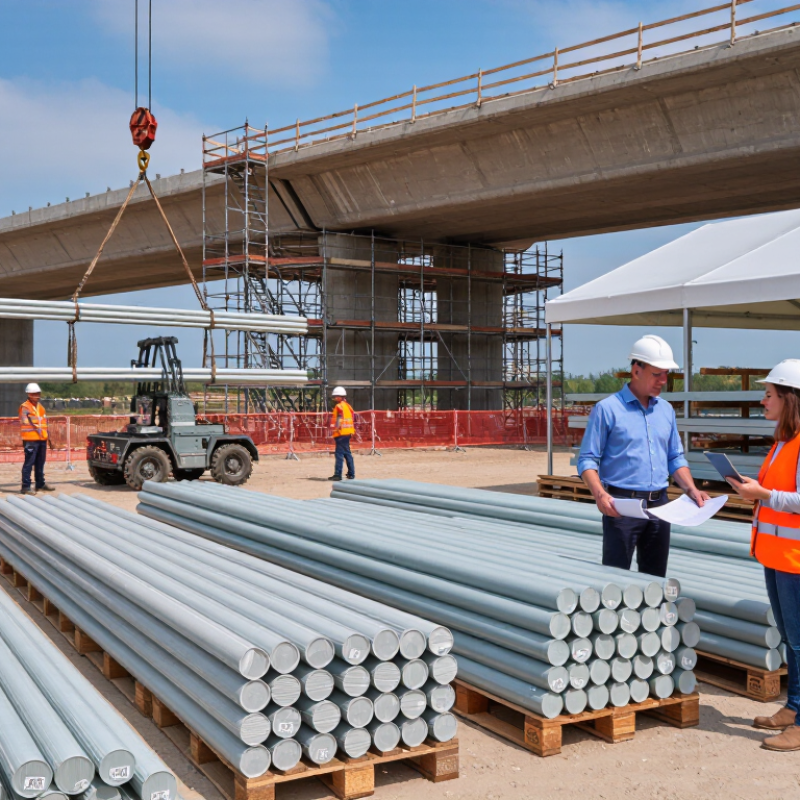
How to Choose GFRP Bars for Global Construction Projects?

Set Project Criteria: 600–1,000 MPa Tensile Strength and Exposure Class

Choosing GFRP bars for global construction projects starts with measurable project criteria. Set a tensile strength range of 600–1,000 MPa before requesting quotations. This range suits many bridge decks, marine structures, parking facilities, and industrial floors. However, ultimate strength alone does not define performance. Check the bar’s guaranteed strength, elastic modulus, diameter tolerance, and bond behavior with concrete. Request independent test reports from accredited laboratories. Certificates should identify test methods, sample conditions, and production dates.

Exposure class deserves equal attention. A coastal bridge may face chlorides, wetting cycles, and temperature changes. An underground tank may experience constant moisture and chemical contact. Freeze-thaw exposure also changes the design approach. Match the reinforcement to the project’s environmental classification and service life target. Then confirm the reduction factors required by the governing design code. These factors can significantly reduce the usable tensile capacity. Do not design with the factory value alone.

Field experience suggests checking installation details early. GFRP bars are strong in tension but cannot be bent on site like steel. Confirm factory-bent shapes, minimum bend diameters, cutting tools, and storage conditions. Keep bars off the ground and protected from prolonged sunlight. I have seen schedules fail because bending requests arrived after production. That mistake is avoidable. Still, local climate data and code interpretations may be incomplete during early design. Recheck assumptions with a qualified structural engineer, especially when exposure conditions overlap.

Screen Codes: ACI 440.11-22, CSA S807, and ISO 10406-1 Compliance

Choosing GFRP bars for a global project begins with the governing design code, not a product brochure. ACI 440.11-22 provides requirements for GFRP-reinforced concrete buildings in applicable jurisdictions. CSA S807 addresses GFRP reinforcement used in concrete construction under Canadian practice. ISO 10406-1 supports testing and evaluation of fiber-reinforced polymer bars. It is not a substitute for local structural rules.

Check the project location, occupancy, exposure, and approval pathway. Then compare bar diameter, guaranteed tensile strength, elastic modulus, bond behavior, and environmental durability. The values should appear in controlled technical documents, not only marketing sheets. Ask for production-lot test reports, calibration records, and traceability from resin batch to shipment. Small gaps matter.

On site confirm bar spacing, bend locations, cover, cutting methods, and storage protection. GFRP bars cannot be treated like steel during handling or field bending. Review thermal effects and fire requirements with the design engineer, because these often influence the final reinforcement layout. A spreadsheet may look complete.

It may still miss local acceptance.

For cross-border work, map each requirement to a drawing note, specification clause, or inspection record. Use ACI 440.11-22 where its scope applies, CSA S807 where Canadian provisions govern, and ISO 10406-1 when test procedures are required. If requirements conflict, document the engineering decision and obtain approval from the responsible authority before procurement. That extra review can feel slow, but replacing nonconforming reinforcement is slower.

Compare Materials: 1.9–2.1 g/cm³ Density and 50–75% Lower Weight

Choosing GFRP bars for global construction projects starts with a practical comparison: density. Typical GFRP reinforcement weighs about 1.9–2.1 g/cm³, while steel is approximately 7.85 g/cm³. This creates a theoretical weight reduction of roughly 73–76%. In real projects, savings are often reported within the broader 50–75% range because bar sizes, spacing, couplers, and packaging affect delivered weight. ACI 440.1R-15 and fib Bulletin 40 identify low density as a major handling advantage for fiber-reinforced polymer reinforcement.

The difference becomes tangible on site. A crew can move longer bundles with less lifting equipment, while trucks may carry more reinforcement per trip. This matters on remote bridges, coastal structures, and projects with restricted access. However, weight alone should not determine selection. GFRP bars have high tensile strength and strong corrosion resistance, yet their elastic modulus is lower than steel. Crack width, deflection, fire exposure, and anchorage require project-specific design checks under applicable standards. The Federal Highway Administration has highlighted these serviceability issues in its technical guidance on FRP bridge reinforcement.

The comparison is not perfect. A lighter bar does not always mean a cheaper structure. Engineers should verify rib geometry, bend limitations, thermal conditions, and local code acceptance before ordering. A spreadsheet may show 70% lower weight, but site handling can still be difficult when bundles are long and flexible. Field experience deserves attention. A small mock-up can expose problems earlier than a polished calculation.

How to Choose GFRP Bars for Global Construction Projects? - Compare Materials: 1.9–2.1 g/cm³ Density and 50–75% Lower Weight

Evaluation Criterion GFRP Bars Carbon-Steel Rebar Stainless-Steel Rebar Design and Procurement Implication
Typical density 1.9–2.1 g/cm³ Approximately 7.85 g/cm³ Approximately 7.7–8.0 g/cm³ GFRP substantially reduces handling, lifting, and transport loads.
Typical weight reduction versus steel About 50–75%, depending on bar size and design quantity Baseline: 0% Approximately 0–2% Confirm the reduction using the project’s final reinforcement schedule rather than density alone.
Typical tensile strength Approximately 600–1,200 MPa Approximately 400–600 MPa for common reinforcing grades Approximately 500–800 MPa, grade-dependent Use certified product values and the governing design standard for structural calculations.
Elastic modulus Approximately 40–60 GPa Approximately 200 GPa Approximately 190–200 GPa GFRP may require crack-width and deflection checks because it is less stiff than steel.
Corrosion resistance Does not rust; resistant to chlorides and many aggressive environments Requires adequate concrete cover and corrosion protection in aggressive exposure High resistance, but performance depends on alloy and exposure conditions GFRP is well suited to marine structures, bridge decks, tunnels, and de-icing salt exposure.
Electrical and magnetic behavior Non-conductive and non-magnetic Electrically conductive and magnetic Electrically conductive; magnetic response varies by alloy Useful near MRI facilities, electrical equipment, rail systems, and sensitive instruments.
Thermal expansion Typically lower than steel in the longitudinal direction; varies with fiber orientation Approximately 11–13 × 10-6/°C Approximately 16–17 × 10-6/°C Check compatibility with concrete and temperature ranges in the project location.
Handling and installation Lightweight; can often be cut with standard abrasive tools Heavy; commonly requires more labor or lifting equipment Heavy; installation practices are similar to carbon steel Review cutting, bending, lap-splice, storage, and personal-protection requirements before installation.
Field bending Generally supplied as straight bars or factory-made bends; not normally field-bent Can usually be bent on site with approved equipment Can usually be bent on site with approved equipment Finalize bar schedules and bend requirements before placing the order.
Fire and high-temperature performance Resin matrix can lose performance at elevated temperatures; requires project-specific fire design Well-established high-temperature design behavior Well-established high-temperature design behavior Do not select GFRP without verifying fire rating, cover, resin system, and local code provisions.
Best-fit applications Marine works, bridge decks, parking structures, tunnels, utility infrastructure, and non-magnetic facilities General-purpose reinforced concrete where corrosion exposure is controlled Projects requiring metallic reinforcement with enhanced corrosion resistance Match the material to exposure class, structural demand, fire requirements, and local approvals.
Key verification documents Product certificate, tensile properties, bond data, durability test results, dimensional tolerances, and applicable code compliance Mill certificate, grade designation, yield strength, ductility, bend-test results, and applicable code compliance Alloy certificate, mechanical properties, corrosion specification, and applicable code compliance Require third-party test reports and project-specific engineering approval before procurement.

Note: Values are typical industry ranges for preliminary comparison only. Actual properties vary by reinforcement diameter, fiber content, resin system, manufacturing process, temperature, exposure conditions, and governing design code. Final selection should be based on certified product data and a project-specific structural design.

Specify Geometry: 10–32 mm Diameters, Ribbed Bond, and Bar Stiffness

GFRP bar geometry affects handling, concrete placement, and structural performance. For many global projects, available diameters range from 10 to 32 mm. The correct size depends on reinforcement demand, cover, spacing, and local design requirements. A 10 mm bar may suit secondary slabs, while a 25 mm or 32 mm bar may serve heavily loaded beams. Never select diameter by substitution alone.

Ribbed surfaces improve mechanical bond with concrete. However, rib height, spacing, and shape must match the approved product data. Deep ribs are not automatically better. They can complicate placement when bars are closely spaced. During site reviews, check that ribs remain undamaged after cutting, bending restrictions, and transport. Concrete should flow around the bars without visible voids. Small installation details matter.

Bar stiffness also deserves careful attention. GFRP has lower elastic modulus than steel, so serviceability often controls design. Deflection and crack width may govern before ultimate strength. Ask for tensile strength, elastic modulus, bond data, and test methods. Compare values from recognized standards, not marketing summaries. A stiff bar can improve handling, yet it may increase placement difficulty. This trade-off is easy to underestimate. Project teams should review diameter, ribbed bond, and stiffness together, then confirm the choice with the responsible structural engineer. Mistakes happen when one attractive property dominates the decision.

Qualify Suppliers: ASTM D7957 Testing, Traceability, and Lot Controls

Choosing GFRP bars for an international project starts with supplier qualification, not a catalog diameter. ASTM D7957/D7957M defines requirements for solid round GFRP bars, including dimensions, surface condition, tensile strength, and modulus. Treat compliance as evidence, not a slogan. Request independent laboratory reports for each production lot. Check the bar diameter, guaranteed tensile strength, elastic modulus, glass transition temperature, and test date.

Traceability must reach the jobsite. Each bundle should carry a lot number linked to raw-material records, production settings, curing conditions, and inspection results. ACI 440.11-22 provides design provisions for GFRP-reinforced concrete, while FHWA technical guidance highlights corrosion resistance as a major reason for selecting GFRP in bridge applications. However, corrosion resistance does not excuse weak quality control. A 2023 FHWA infrastructure report estimated that corrosion costs the United States about 276 billion dollars annually across transportation infrastructure. The number is broad, but the risk is concrete and expensive.

Ask suppliers to explain their sampling plan. Confirm that failed lots are isolated, investigated, and never quietly re-labeled. Compare certificates with third-party test results, not just internal spreadsheets. A spreadsheet can look complete and still hide a weak lot. Also review storage instructions, because ultraviolet exposure, heat, and rough handling can damage bars before placement. I would require a documented chain of custody from factory bundle to installation crew. That may feel excessive. On remote projects, it is often the difference between a durable structure and an uncomfortable dispute.

Article Source: