Top Intelligent Lighting Pole Manufacturers for Global Buyers
Choosing an Intelligent Lighting Pole manufacturer involves more than comparing product photos or headline prices. Global buyers need systems that perform reliably in varied streets, climates, and network conditions. A pole may combine LED lighting, cameras, environmental sensors, public Wi-Fi, and charging equipment. Each added function affects power demand, maintenance access, software compatibility, and installation planning. Small details matter.
This guide introduces manufacturers serving international projects and explains what buyers can examine before requesting a quotation. Useful comparison points include engineering capability, documented project experience, material and finish options, control-platform interoperability, production capacity, and after-sales support. Ask for clear specifications, sample drawings, warranty terms, and references from installations with similar requirements. A well-presented brochure is not proof of long-term performance.
Local conditions also shape a sound decision. Coastal air, heavy rain, high winds, and temperature swings can expose weaknesses in enclosure design or surface treatment. Buyers should confirm which performance claims are tested and documented, rather than assuming every configuration has the same rating. Check whether the supplier can coordinate the pole, luminaires, brackets, sensors, and control equipment as one workable system. Compatibility can be tedious. It is still important.
No manufacturer is the right fit for every project, and supplier rankings can change as products and service networks evolve. This overview offers a practical starting point, not a substitute for technical review. Compare evidence, clarify responsibilities, and match the proposed solution to the site’s actual needs. A careful shortlist can prevent costly surprises later.
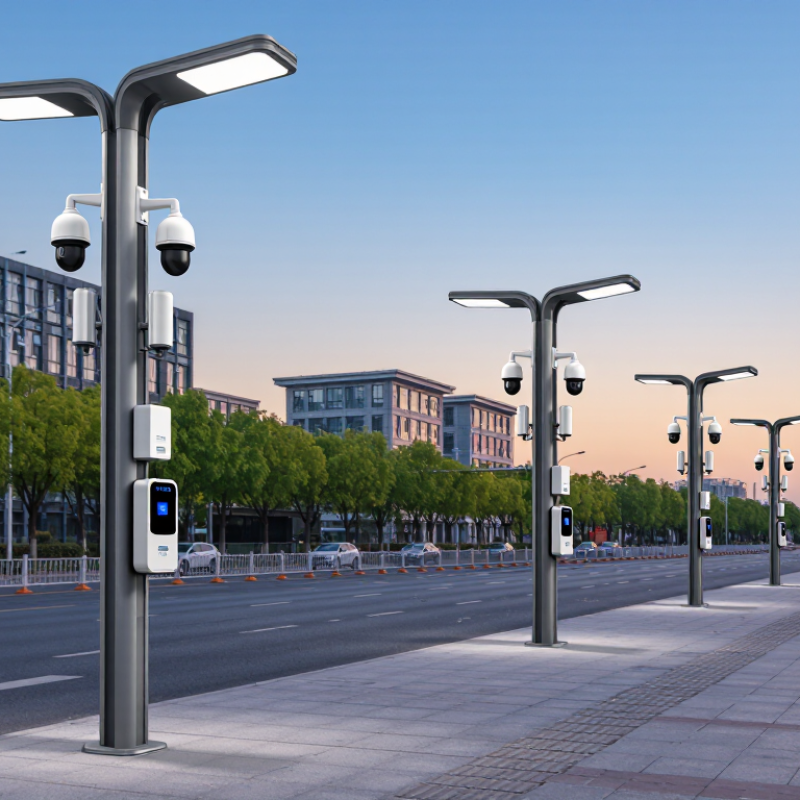
What Intelligent Lighting Poles Are and How They Work
An intelligent lighting pole combines a streetlight with sensors, a controller, and communications equipment. Its LED fixture can dim or brighten according to schedules, movement, or ambient light. Sensors may also monitor temperature, air quality, or traffic, depending on the installation. The controller sends readings to a management platform, where operators can adjust settings and spot faults remotely. In practical terms, a technician may diagnose a failed lamp without driving out to inspect every pole. Useful, but not infallible.
Energy savings depend on the existing lamps, dimming schedules, and local conditions. The U.S. Department of Energy’s 2017 report, Adoption of Light-Emitting Diodes in Common Lighting Applications, describes substantial energy-saving potential from LED street lighting compared with traditional technologies. Networked controls can help avoid lighting empty streets at full output, though poor sensor placement may create dark patches or unnecessary brightness. That detail is easy to overlook.
Tips: Check pole spacing, sensor coverage, and communications range during a site survey. Ask for measured energy data, not only projected savings. Confirm who maintains the software and replaces failed components; a smart pole still needs ordinary maintenance.
Key Technologies and Global Applications of Intelligent Lighting Poles
Intelligent lighting poles combine LED luminaires with sensors, communications equipment, and control systems. Their central technology is adaptive lighting: controllers can adjust brightness using schedules, movement data, or ambient light readings. This can reduce wasted illumination while keeping walkways and roads usable. A well-designed pole also considers heat dissipation, surge protection, access for maintenance, and secure equipment mounting. Integration is not always simple; devices from different suppliers may not communicate reliably.
Global applications vary with local conditions. In dense urban districts, poles may support traffic monitoring, pedestrian counting, or public Wi-Fi alongside street lighting. Industrial sites often need durable housings that tolerate dust, vibration, and temperature swings. Rural roads may benefit from solar power and battery storage where grid connections are limited, though cloudy periods can reduce available energy. One weakness deserves attention: adding many devices increases maintenance needs and can make troubleshooting harder.
Tips: Ask manufacturers for test data on light distribution, ingress protection, and operating temperature. Check whether controls work during network outages, and confirm that replacement parts are available locally. Small details matter.
How to Assess Intelligent Lighting Pole Manufacturers
Assess a manufacturer by evidence, not renderings. Request project references, pole drawings, load calculations, and photometric files for the exact configuration. Check that the stated wind rating matches your site’s exposure, pole height, and mounted equipment. The IEA estimates that lighting uses about 15% of global electricity and causes 5% of greenhouse-gas emissions, making efficiency claims worth checking.
Ask for independently verified lumen output, power draw, thermal test results, and corrosion-protection data. Compare measurements at operating temperature, not only under laboratory conditions. For connected poles, review network updates, access controls, and data handling. NISTIR 8259A identifies core IoT security capabilities, including secure configuration and data protection. Useful guidance. Also inspect spare-part availability and warranty exclusions.
Request a sample pole or small-site pilot before approving a citywide order. Watch for loose cable glands, water pooling, hard-to-reach drivers, and glare across nearby windows. Ask who diagnoses failures remotely and who replaces a controller on site. A neat demo proves little. Treat vague lifetime claims cautiously; control electronics may fail before the LED module. That uncertainty deserves a written service plan.
How to Assess Intelligent Lighting Pole Manufacturers
Suggested evaluation weights for comparing suppliers. These are a practical assessment framework, not measured market statistics.
Prioritize verified compliance, interoperability, and lifecycle support alongside the pole’s core engineering. Adjust the weights to match project requirements and local regulations.
Manufacturer Capabilities, Product Ranges, and Regional Markets
For global buyers, an intelligent lighting pole is more than a lamp on a mast. Strong manufacturers combine LED luminaires, control nodes, sensors, and communications equipment on a serviceable structure. Typical ranges include different pole heights, mounting arms, dimming controls, and options for cameras or environmental sensors. Buyers should check load limits, corrosion protection, access panels, and spare-part availability. Details matter. A neat product catalogue does not prove that components will work together after installation.
Regional demand shapes these capabilities. UN DESA’s World Urbanization Prospects 2018 estimated that 55% of people lived in urban areas in 2018, rising to 68% by 2050. This long-term shift supports investment in connected public infrastructure, but local needs differ. Coastal projects may require stronger corrosion resistance; hot, dusty locations need suitable thermal management and sealed enclosures.
Manufacturers serving multiple regions should provide clear photometric files, electrical specifications, and commissioning support. Field conditions vary. Buyers should also ask for interoperability test records and realistic maintenance intervals, not just connectivity claims.
One limitation remains: published specifications rarely capture installation quality or local network reliability. A pilot installation can reveal issues that a datasheet misses.
How Global Buyers Compare and Select Suppliers
Global buyers should compare intelligent lighting pole suppliers by evidence, not brochure claims. Ask for references from projects in climates similar to yours, including coastal salt air or freeze-thaw winters. Review pole drawings, material grades, coating details, and wind-load calculations. Request test reports covering the complete assembly: luminaires, sensors, gateways, and control software. Details matter. A polished sample can still hide awkward cable access or limited maintenance clearance.
Check how suppliers verify production quality, manage custom specifications, and support installation across time zones. Confirm that control systems can communicate with your intended platform, and ask how firmware updates and data access are handled. One common blind spot is comparing unit prices before checking spare-part availability and delivery schedules. A small pilot can expose issues early: test sensor response at dusk, inspect cabinet access, and review fault alerts with the local maintenance team. It is not a perfect guarantee. Still, clear records, practical demonstrations, and candid answers make supplier comparisons more reliable.