
Contract Manufacturing for Injection Molded Plastic Products in North America
(800) 824.0607

RFQ / CONTACT
Contract Manufacturing for Injection Molded Plastic Products in North America | (800) 824.0607

Best Cantilever Rack Manufacturer in China?

Choosing the best Cantilever Rack manufacturer in China requires more than comparing prices. It means checking whether the rack fits the load, the building, and the daily handling process. Cantilever arms support long, bulky goods without front columns. That makes them useful for timber, steel sections, pipes, and sheet materials. Small design errors matter. A load that projects too far can change how the rack behaves.

Industry reports offer helpful context, but they cannot certify an individual supplier. MHI’s 2024 Annual Industry Report, based on a survey of more than 2,000 supply chain professionals, reported that 55% expected to adopt artificial intelligence within five years. The finding reflects growing interest in technology and operational efficiency, not a guarantee of better rack quality. Grand View Research’s warehouse racking market analysis also tracks continued demand for storage systems. Buyers should still verify specifications directly.

Look closely at steel grade, arm capacity, upright spacing, surface finish, and installation guidance. Ask for load-rating documents and drawings that match your intended configuration. Check whether the manufacturer can explain how capacity changes across different arm positions. A polished catalog is not enough. Nor is the lowest quotation. There is no flawless supplier, and a factory visit or independent inspection may reveal details a brochure cannot. These checks take time. They can prevent expensive surprises after delivery.
Best Cantilever Rack Manufacturer in China?

What Is a Cantilever Rack and Which Materials Does It Store?

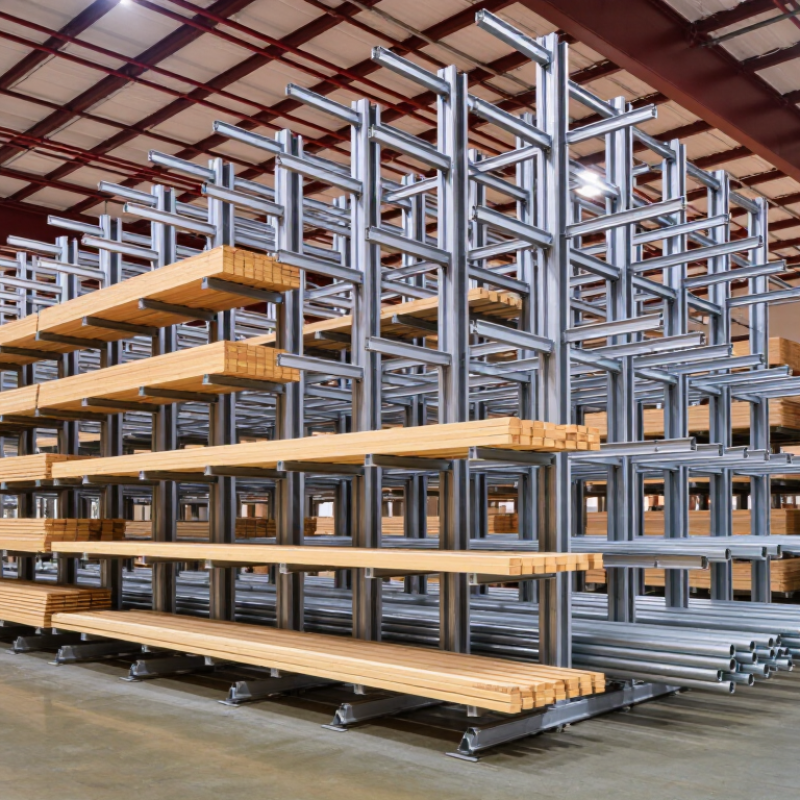
A cantilever rack is a storage system built around upright columns, horizontal arms, and a braced base. Unlike a pallet rack, it has no front posts blocking access. Long materials can be loaded from the side with a forklift or handled by hand when their weight allows. Simple in appearance. Not simple to size.

These racks commonly hold lumber, steel pipes, metal tubing, plastic conduit, and long structural profiles. They can also store bundled trim or similar awkward items that do not sit neatly on standard shelves. Sheet goods may fit with suitable decking and handling equipment, but they are not automatically a good match. Check how each load rests on the arms. Narrow contact points can cause movement or damage.

Choose arm length and capacity for the actual load, not an estimate based on appearance. Weight should be distributed as the rack’s design requires, and long items should not overhang without a clear handling plan. In practical warehouse reviews, small measurement errors can become inconvenient fast. A rack may technically fit, yet leave too little room for forklift turns.

Consider indoor or outdoor use, too; moisture exposure can affect the finish and maintenance needs. Ask the manufacturer for rated capacities and installation guidance. Even a sturdy rack needs inspection.

How Is China’s Cantilever Rack Manufacturing Industry Structured?

Best Cantilever Rack Manufacturer in China?

How Is China’s Cantilever Rack Manufacturing Industry Structured?

China’s cantilever rack industry is a supply chain, not a single factory model. Steel suppliers provide coil, tube, and plate; rack producers cut, punch, weld, and form these materials into columns, arms, and bracing. Some plants handle most steps in-house. Others outsource galvanizing or powder coating. This difference affects lead time, traceability, and who resolves defects. Details matter.

Engineering teams translate load data, product length, and site layout into a rack configuration. They check arm capacity, upright spacing, anchoring, and forklift clearance. Fabrication may use laser cutting, drilling lines, welding jigs, and coating booths. A neat finish is visible; weld consistency and dimensional accuracy need documented checks. A sample inspection can reveal issues, but it cannot replace production records or installation review.

Beyond manufacturers, the sector includes trading companies, export agents, and warehouse-system integrators. They may coordinate drawings, packing, shipping, and on-site assembly, while core fabrication stays elsewhere. That division can be efficient, but responsibility can blur when a change is made late. Ask who approves revised drawings and verifies rated loads. Also compare material specifications, inspection reports, and spare-part availability, not just quoted price. No supplier is perfect; a clear process makes shortcomings easier to catch.

Best Cantilever Rack Manufacturer in China? — How Is China’s Cantilever Rack Manufacturing Industry Structured?
Industry Layer Typical Role Products or Capabilities Useful Evaluation Criteria Buyer Considerations
Steel and component suppliers Supply the raw materials and purchased components used by rack producers. Structural steel sections, plate, fasteners, base plates, and coating materials. Material selection depends on the rack design and intended loads. Material traceability, agreed specifications, consistency of supply, and inspection documentation. Confirm that material grades and dimensions match the approved design and project requirements.
Rack manufacturers Turn steel inputs into cantilever rack components and complete systems. Columns, bases, arms, bracing, connectors, and single- or double-sided rack layouts. Products may be made for indoor or outdoor use. Manufacturing controls, dimensional accuracy, weld quality, component fit, and documented quality checks. Ask whether the quoted scope includes engineering, fabrication, finish, packaging, and installation support.
Engineering and design teams Translate inventory, site, and handling requirements into a rack layout and structural design. Load calculations, bay layouts, arm spacing, clearances, anchorage details, and drawings for project review. Design assumptions, stated load limits, review process, and alignment with applicable local requirements. Provide product dimensions, unit weights, handling equipment details, floor information, and site conditions.
Surface-treatment providers Apply finishes intended to protect steel and suit the operating environment. Common options include powder coating and hot-dip galvanizing; the appropriate finish depends on exposure and service conditions. Specified coating system, surface preparation, coverage, finish inspection, and suitability for the environment. For outdoor or corrosive environments, define the exposure conditions and finish requirements before ordering.
System integrators and project contractors Coordinate racks with warehouse layouts, handling equipment, and project installation. Site coordination, installation planning, layout integration, and, where included, commissioning or handover documentation. Installation method, project references, schedule coordination, safety procedures, and after-sales support. Clarify responsibility for unloading, floor checks, anchors, installation, and final inspection.
Export and distribution channels Connect domestic production with overseas buyers and local project teams. Export packing, shipping coordination, documentation, communication, and coordination with local distributors or contractors. Clear commercial terms, packing details, lead-time assumptions, document accuracy, and response process. Confirm the delivery scope, transport responsibilities, spare-parts arrangements, and who handles local support.
Cantilever rack product configurations Serve storage needs for long, bulky, or irregularly shaped loads that are difficult to store on conventional pallet rack beams. Single-sided or double-sided layouts; adjustable arms are common. Systems can be specified for different load lengths and handling methods. Arm and column capacity, load distribution, rack height, aisle clearance, stability, and compatibility with the handling equipment. Capacity is design-specific; compare systems only when load assumptions and configuration are equivalent.
Quality and safety verification Check that the supplied system matches its approved design and stated use. Drawing review, production inspection, installation checks, operating instructions, and load-rating documentation as applicable. Traceable records, inspection scope, clear operating limits, and documented procedures for changes or damage. Do not infer a safe working load from appearance alone; request project-specific documentation.
How to compare manufacturers: Evaluate engineering capability, production and inspection controls, finish suitability, documentation, delivery scope, and support against the same project specification. Rack capacity and configuration depend on the design, load arrangement, installation, and site conditions; verify these details for each project.

What Criteria Help Identify a Reliable Cantilever Rack Manufacturer?

Choosing a reliable cantilever rack manufacturer means checking engineering evidence, not showroom appearance. Request project-specific drawings and load tables. They should identify arm capacity, column capacity, bay spacing, material grade, and allowable deflection. The design should reflect the actual goods: a bundle of steel pipes loads a rack differently from timber boards. Ask whether calculations follow ANSI MH16.3, the industry standard for cantilever rack design. Details matter.

Manufacturing quality deserves a close look. Ask how welds are inspected, how steel grades are traceable, and what finish protects racks in your operating environment. A neat weld is not proof of structural quality; I would want documented inspection procedures and clear acceptance criteria. Request installation guidance, maintenance instructions, and a written warranty. Ask for records.

Digital records can help with traceability. MHI’s 2024 Annual Industry Report found that 55% of surveyed supply-chain professionals planned to increase technology investment. That figure does not prove a rack maker is reliable, but it shows why clear digital drawings, inspection logs, and replacement-part records are useful. Check whether the manufacturer can supply these documents and answer technical questions after delivery. A slow or vague response before purchase may be a warning sign.

Best Cantilever Rack Manufacturer in China? Material Verification Criteria

Compare specified minimum yield strengths for common structural steel grades when reviewing material certificates from a cantilever rack manufacturer.

ASTM A36 is shown at 36 ksi; ASTM A572 Grade 50 and ASTM A992 are shown at 50 ksi. Confirm the applicable standard, product form, thickness, and mill test certificates. Steel strength alone does not establish rack capacity or safety; those depend on the complete engineered design.

How Do Manufacturing Quality, Safety Standards, and Customization Compare?

Best Cantilever Rack Manufacturer in China?

When comparing manufacturers, look beyond price and catalog photos. Ask for steel-grade records, weld inspection procedures, coating specifications, and documented load testing. Small details matter. RMI’s ANSI MH16.3 standard covers the design, testing, and use of industrial steel cantilever racks. Request drawings that show rated arm and column capacities, not just total system load. OSHA cites about 85 deaths and 34,900 serious injuries annually involving powered industrial trucks; these figures are not rack-specific, but they underline the need to consider rack stability, clearances, and safe handling together.

Customization should start with the actual stock: long pipes, timber bundles, or sheet materials have different support needs. Share product lengths, unit weights, forklift type, aisle width, and site conditions before approving a design. A capable supplier should explain how arm length and spacing affect capacity, and provide calculations for the proposed layout. More customization is not always better; unusual dimensions can complicate replacement parts and inspections. Ask how components are identified and whether the supplier can provide installation guidance and maintenance records.

Tips: Request a sample inspection report and a project-specific drawing. Check that quoted capacities match the configuration you will install. If the explanation is vague, pause and ask for clarification. A neat brochure is not proof of engineering quality.

What Should Buyers Check Before Choosing a Chinese Supplier?

A Chinese cantilever-rack supplier should provide more than a low quote. Ask for drawings showing arm length, column spacing, base dimensions, and rated loads. Check that the capacity applies to your actual storage layout, not a generic example. Request material certificates, weld inspection records, coating specifications, and a clear process for reporting defects. Vague answers matter.

Review the supplier’s quality controls in person or through an independent inspection. Check sample welds, measure key dimensions, and confirm packaging protects long arms during ocean shipping. Ask for export references and spare-part availability. A polished brochure proves little. One prototype also cannot confirm every production batch.

Safety deserves equal scrutiny. The U.S. Bureau of Labor Statistics recorded 5,283 fatal work injuries in 2023 and 2.6 million nonfatal cases in private industry. These figures cover many kinds of work, not rack incidents specifically, but they reinforce the value of verifiable safety checks. Ask whether designs follow applicable rack engineering standards, such as ANSI MH16.1, and request calculations for your loads and site conditions. There is no perfect checklist; unclear load assumptions are an easy detail to miss.