
Contract Manufacturing for Injection Molded Plastic Products in North America
(800) 824.0607
China’s factory floors are changing, but not in one uniform way. A robot moving cartons through a busy warehouse faces different demands from one feeding a production line. This guide to the Top 10 Material Handling Robot Manufacturers in China examines how suppliers address those everyday tasks, from pallet transport to machine tending.
Joseph Engelberger, widely regarded as a pioneer of industrial robotics, once said, “I can’t define a robot, but I know one when I see one.” The line is a useful reminder: a polished product photo tells little about performance. Buyers should look at payload, navigation, safety features, integration support, service access, and how reliably a system handles real operating conditions. Small details matter. A narrow aisle can change the whole plan.
The manufacturers featured here are compared through practical criteria, not claimed as a universal ranking. Product range, deployment experience, technical documentation, and support capacity can help readers build a shortlist. Yet public information is uneven, and a supplier’s stated capabilities do not guarantee results at every site. That is worth questioning. Before choosing, request a site assessment, verify references, and test the proposed workflow against your own loads and floor layout. A careful comparison can narrow the field, but the final fit depends on the operation itself.
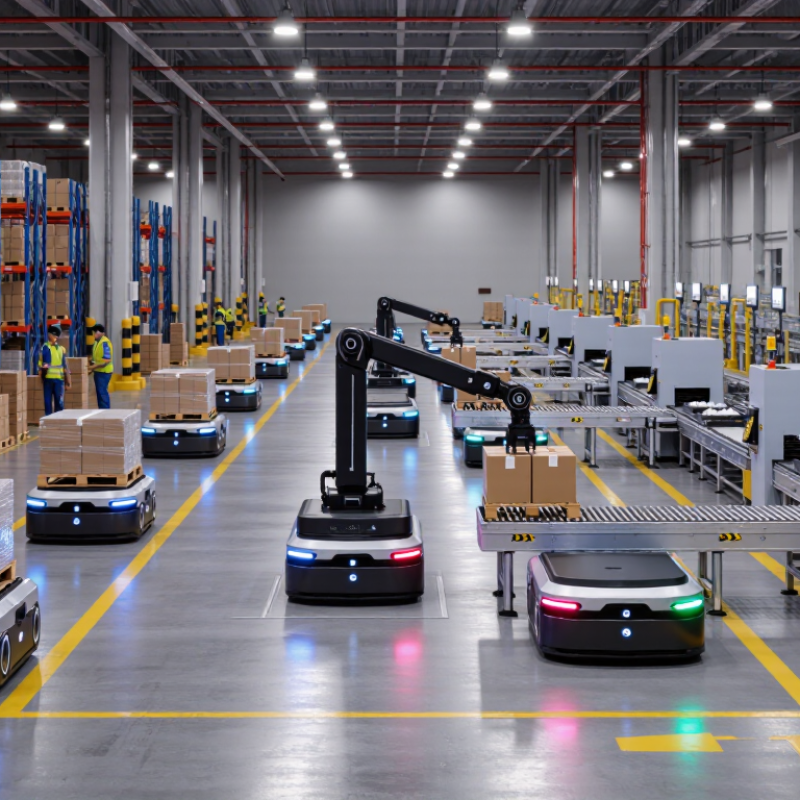
Material Handling Robots move, lift, transfer, or position goods within factories and warehouses. They may carry bins between workstations, load pallets, or feed parts into production equipment. Some follow fixed routes; others use sensors and mapped paths to navigate changing layouts. Their usefulness depends on the task, payload, travel distance, and surrounding traffic. Not magic.
In daily operations, these systems can reduce repetitive lifting and keep materials moving between process steps. A robot may deliver a component trolley to an assembly cell while workers focus on inspection or fitting. Sensors, scanners, and controlled speed help it detect people and obstacles, but safe operation still depends on suitable site design and risk assessment. A narrow aisle can defeat a capable machine. That detail is easy to miss.
Choosing a system starts with observing the actual workflow, not just counting trips. Engineers typically check load weight, turning space, floor conditions, handoff points, and how often routes change. They also consider charging, maintenance access, and integration with doors or conveyors. Trial runs can expose awkward stops and confusing traffic patterns before broader deployment. Plans look neat on paper; factory floors rarely do. Human oversight remains important, especially when products, layouts, or schedules change.
Material handling robots move, lift, sort, or position goods across factories and warehouses. Common types include automated guided vehicles, autonomous mobile robots, robotic palletizers, and fixed-arm transfer systems. AGVs follow marked routes or installed guidance, while AMRs use onboard sensors to navigate around changing obstacles. In a busy warehouse, that may mean steering around a parked cart rather than stopping the whole line. Small details matter.
The International Federation of Robotics reported 276,288 industrial robot installations in China in 2023, about 51% of global installations. This figure covers industrial robots broadly, not material handling units alone, so it should not be read as a category-specific market count. Still, it shows the scale of China’s automation environment.
Palletizing robots suit repetitive stacking at the end of production lines; mobile robots support flexible movement between storage and workstations. Some sites combine both. The fit depends on load weight, aisle width, floor conditions, and how often routes change. I would be cautious about treating “autonomous” as fully hands-off: charging, safety checks, and route adjustments still require attention.
Assess a material handling robot manufacturer by asking for evidence from a working site, not only a polished demonstration. The International Federation of Robotics reported 276,288 industrial robot installations in China in 2023. That figure shows a large automation market, but it does not prove a supplier’s material handling systems will perform well in your facility. Numbers need context.
Match the robot’s payload, travel distance, turning radius, and charging plan to real operating conditions. Ask for cycle-time results with your actual load and route. Watch it pass through a busy aisle, stop near people, and recover after a blocked path. No factory is perfectly tidy. A demo should reflect that. Check which warehouse systems the robot can connect to, and request a clear plan for installation, staff training, spare parts, and software updates.
MHI’s 2024 Annual Industry Report found that 55% of surveyed supply chain professionals planned to invest in robotics and automation. Interest is strong, but investment alone is not a performance measure. Ask for uptime records, maintenance logs, and references from sites with similar shifts and floor conditions. Compare total operating costs, not just the purchase price. I would still treat impressive claims cautiously; suppliers may not measure downtime in the same way. Ask them to define every metric in writing.
Suggested evaluation weights for comparing manufacturers—not company ratings or market statistics.
Compare each manufacturer against the same criteria and adjust the weights to reflect your application, facility, and operating priorities.
China’s material-handling robot market includes suppliers with different strengths, so a useful profile looks beyond headline rankings. One manufacturer may focus on compact autonomous mobile robots for narrow aisles and frequent route changes. Another builds automated guided vehicles for steady, repeatable pallet transfers. A third specializes in robotic forklifts, where accurate pallet detection matters at every lift. A fourth combines robots with warehouse software and conveyor equipment. Integration can be valuable, but it may also make future upgrades more complicated. A fifth develops heavy-load platforms for moving machinery or large components across factory floors.
Other manufacturers concentrate on specific warehouse tasks. One designs shuttle systems for dense pallet storage and high-throughput retrieval. Another supplies mobile robots for tote movement between picking stations. A vision-focused maker works on robotic picking, where irregular packaging can slow performance. A further supplier targets cold-storage sites, where batteries, sensors, and components face demanding conditions. The tenth profile is a systems builder that adapts fleets to existing layouts. Details matter. Buyers should check payload limits, aisle width, floor condition, software compatibility, and local service response. Published performance figures need context; real operating results can differ. That distinction is easy to overlook.
A useful comparison of material handling robot manufacturers in China starts with the work each system must perform. Some manufacturers focus on autonomous mobile robots that move bins through narrow warehouse aisles. Others build pallet-handling systems, robotic arms, or integrated conveyor solutions. Check navigation methods, payload limits, positioning accuracy, and how robots behave around people and changing obstacles. A polished demonstration is useful, but a busy shift is the real test.
Applications reveal where a design fits. A distribution center may need flexible routes and frequent software updates, while a factory may value repeatable transfers between fixed stations. Ask for evidence from sites with similar floor conditions, loads, and operating hours. Look closely at battery changes, charging plans, and recovery procedures when a robot stops unexpectedly. Small details matter. A specification sheet may not show how much operator attention a system needs.
Service quality is harder to compare, yet it can shape long-term performance. Review installation support, training, spare-parts access, response times, and the process for diagnosing faults remotely. Request a clear commissioning plan and measurable acceptance criteria. Speak with existing users when possible, and ask what happened after the first year. No comparison is perfect; vendor-provided case studies may leave out awkward lessons. That is worth remembering.
An anonymized, category-based comparison of common material-handling robot capabilities available from manufacturers in China. The profiles are not named companies, verified rankings, or company-specific specifications; equipment options and performance vary by model and project.
| Profile | Typical Robot Focus | Navigation and Control | Typical Payload Class | Common Applications | Integration Considerations | Service Factors to Compare |
|---|---|---|---|---|---|---|
| 01 | AMRs for goods-to-person transport | Natural-feature mapping with onboard obstacle detection; fleet software coordinates vehicle traffic. | Light to medium payloads; exact limits depend on the vehicle and load interface. | Bin, tote, and carton movement in e-commerce and distribution operations. | Check lift or conveyor interfaces, warehouse-system connectivity, traffic rules, and charging strategy. | Evaluate mapping support, software updates, spare-part availability, and local response arrangements. |
| 02 | Heavy-load autonomous mobile robots | Laser-based or other sensor-based localization, with safety-rated obstacle detection on suitable models. | Medium to heavy loads; capacity is model-specific and must include the load carrier. | Moving pallets, racks, fixtures, and production materials between work areas. | Review floor conditions, turning space, load stability, aisle access, and emergency-stop integration. | Confirm commissioning coverage, preventive-maintenance plans, battery service, and recovery procedures. |
| 03 | Counterbalanced and fork-style AGVs | Commonly use fixed routes, reflectors, magnetic guidance, or laser navigation, depending on the system. | Typically designed for pallet-scale loads; rated capacity and lift height vary by model. | Repetitive pallet transfer, line feeding, and warehouse-to-production movement. | Assess pallet condition, pickup/drop-off tolerances, rack clearance, and route-change requirements. | Compare route-reconfiguration support, safety validation, operator training, and maintenance access. |
| 04 | Under-rack and latent-lift AMRs | Mobile platforms navigate beneath compatible racks or carts and lift them for transport. | Load capacity depends on the platform, lifting mechanism, and rack design. | Moving storage racks, work-in-process, and order-picking units. | Verify rack dimensions, floor flatness, docking repeatability, and fleet traffic management. | Check rack-interface engineering, fleet diagnostics, and the availability of replacement lift components. |
| 05 | Conveyor-top mobile robots | Mobile navigation paired with powered roller or belt transfer for controlled handoffs. | Usually specified by both robot payload and conveyor transfer capacity. | Carton, tote, and case transfer between workstations, sortation areas, and conveyors. | Confirm conveyor height, transfer speed, photo-eye logic, and handshake signals with fixed equipment. | Compare controls integration, fault-diagnosis tools, and support for conveyor and robot subsystems. |
| 06 | Tugger and tow-train AGVs | Route-following or mapped navigation; trains can link multiple carts where the site layout permits. | Specified by towing capacity and train configuration rather than a single carried payload. | Milk-run delivery, line-side replenishment, and scheduled movement of carts. | Review tow-hitch design, cart braking, route width, pedestrian crossings, and docking points. | Assess route planning, cart compatibility, fleet uptime reporting, and operator safety training. |
| 07 | Robotic palletizing and depalletizing cells | Industrial robot arm with programmed trajectories; vision may be used for selected mixed or variable loads. | Arm payload and reach must be matched to the product, gripper, and pallet pattern. | Case stacking, pallet building, pallet breakdown, and end-of-line handling. | Check cycle-time assumptions, product variation, gripper design, guarding, and upstream/downstream interfaces. | Compare application engineering, safety documentation, recipe changes, and commissioning support. |
| 08 | Robotic depalletizing and case-handling systems | Robot arms may combine barcode reading, 2D or 3D vision, and configurable picking tools. | Depends on the arm, end effector, case dimensions, and required reach. | Unloading mixed or uniform cases for sorting, storage, or production feeding. | Test representative packaging, label quality, stack variation, and recovery from failed picks. | Ask about vision tuning, product-changeover support, gripper spares, and ongoing software assistance. |
| 09 | Compact mobile robots for manufacturing logistics | Mapped navigation or guided routes, often configured for frequent point-to-point missions. | Generally suited to small or medium parts and containers; check the rated payload for each model. | Machine tending support, kitting, component delivery, and work-in-process transport. | Review machine-door or lift interfaces, workcell access, dispatch logic, and cycle synchronization. | Compare integration with manufacturing execution systems, diagnostics, and support during shift changes. |
| 10 | Custom material-handling robot integrators | May combine mobile bases, robot arms, vision, conveyors, lifts, and site-specific controls. | Defined by the engineered system rather than a single standard robot specification. | Non-standard transfers, mixed automation projects, and specialized production logistics. | Request a documented scope, interface list, safety concept, acceptance criteria, and expansion plan. | Compare project management, commissioning resources, documentation quality, and long-term parts support. |
Payload figures are intentionally described by equipment class rather than stated as company-specific values. Before purchasing, verify model-level capacity, speed, accuracy, safety certifications, site compatibility, total cost of ownership, and service coverage directly with the supplier.