
What Are the Top Electromagnetic Wire Types in 2026?
Electromagnetic Wire is a quiet component with a demanding job. It carries current inside motors, transformers, generators, and increasingly compact power systems. In 2026, choosing a wire type means balancing electrical efficiency, heat resistance, insulation, and manufacturing needs. There is no single winner for every design.
The International Energy Agency’s Global EV Outlook 2024 reports nearly 14 million electric cars sold worldwide in 2023, about 18% of all car sales. Its Electricity 2024 report projects global electricity demand will grow by an average of 3.4% annually through 2026. These figures do not measure wire sales. They do show why reliable conductors matter as transport and power systems change.
This guide compares common options: enamelled round and rectangular copper wire, aluminium magnet wire, and specialized constructions such as litz and self-bonding wire. Each has trade-offs. Rectangular wire can pack tightly into motor slots; litz wire can help manage high-frequency losses, but adds complexity. Copper often conducts better, while aluminium can reduce weight. Details matter. The right choice depends on the operating temperature, frequency, available space, and production process—not a label alone. One point deserves caution: “top” is not a universal ranking. A wire that performs well in a laboratory may prove awkward on a fast production line. That distinction is easy to miss.
How Electromagnetic Wire Is Defined and Classified
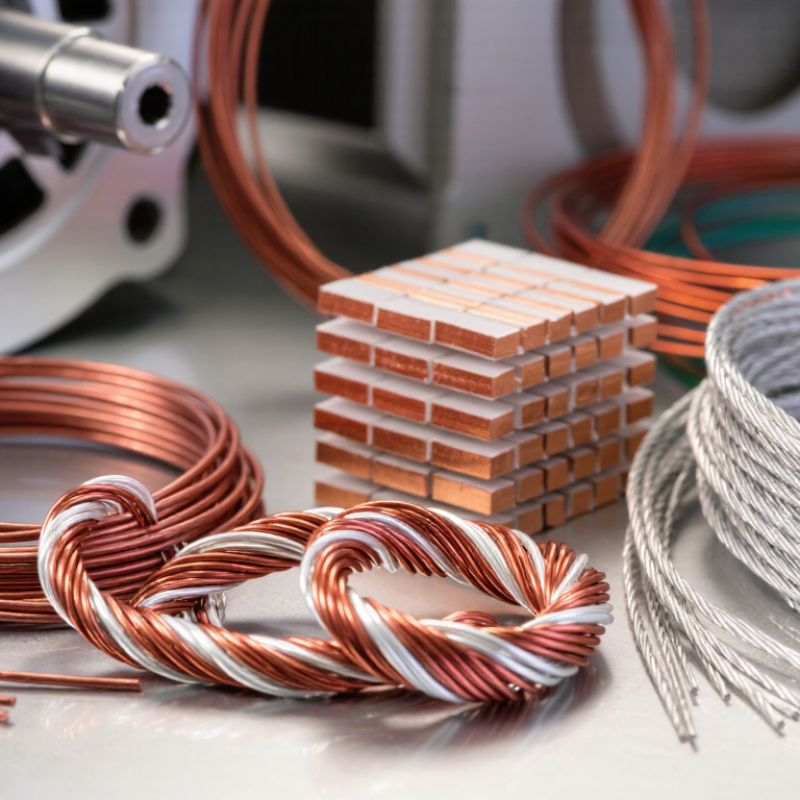
Electromagnetic wire, often called winding wire, is a conductor designed to carry current inside coils. Those coils appear in motors, transformers, relays, and inductors. The conductor is usually copper or aluminum, while a thin insulating layer keeps adjacent turns from shorting. That layer may be enamel, polymer film, or a fibrous covering, depending on operating conditions. Small differences matter. Insulation must tolerate heat, voltage stress, vibration, and any moisture or chemicals present in service. Selecting wire by appearance alone is risky; similar-looking types can have different thermal limits.
Classification begins with conductor material and cross-sectional shape. Round wire winds neatly in compact coils; rectangular wire can use space more efficiently in some designs. Another distinction is the insulation system: enamel-coated wire is common, while film-wrapped or fiber-covered types serve particular mechanical or thermal needs. Wire is also grouped by temperature rating and dimensions, such as diameter and coating thickness. Engineers compare voltage, current, winding space, cooling, and manufacturing method against published specifications. Standards and test data matter. Classification is not perfectly neat. Coatings can overlap, and performance depends on the finished coil, not only its label.
What Are the Top Electromagnetic Wire Types in 2026? - How Electromagnetic Wire Is Defined and Classified
| Wire type | Conductor and shape | Insulation or construction | Typical characteristics | Common applications |
|---|---|---|---|---|
| Round enamelled copper wire | Copper; round cross-section | One or more layers of insulating enamel | Widely used winding-wire format; enamel provides electrical insulation while keeping the winding compact. | Motors, transformers, inductors, relays, and solenoids |
| Rectangular enamelled copper wire | Copper; rectangular or square cross-section | Insulating enamel applied around the conductor | Flat sides can support efficient space use in suitably designed slots and windings. | Motors, generators, transformers, and other space-constrained coils |
| Enamelled aluminum wire | Aluminum; commonly round or rectangular | Insulating enamel matched to the wire’s design requirements | Lower density and lower electrical conductivity than copper; conductor dimensions must account for the application’s electrical and thermal requirements. | Selected motors, transformers, and lightweight winding designs |
| Self-bonding magnet wire | Usually copper; round or rectangular options are available | Base insulation plus a bondable outer coating that can adhere between turns under specified heat or solvent conditions | Can form a more self-supporting coil without relying solely on a separate bobbin or additional binding. | Compact coils, small motors, sensors, and specialty inductors |
| Paper-covered copper wire | Usually flat or rectangular copper conductor | Electrical-grade paper wrapped around the conductor, sometimes in multiple layers | Layered paper insulation is used in winding designs where the insulation system is compatible with the equipment and its operating environment. | Oil-immersed transformers and other transformer windings |
| Glass-fiber-covered wire | Typically copper; round or rectangular forms | Glass-fiber covering; varnish or resin impregnation may be used as part of the insulation system | Textile-covered construction is selected for particular thermal, mechanical, or manufacturing requirements; performance depends on the complete insulation system. | Selected generators, motors, and high-temperature electrical coils |
| Heavy-build or multi-coat enamelled wire | Usually copper; commonly round, with other geometries available | Multiple enamel layers or a specified heavier insulation build | Insulation build is chosen to meet the required electrical, mechanical, and processing characteristics; it is not a separate conductor material. | Windings requiring a particular insulation build, including some motors and transformers |
Definition and classification: Electromagnetic wire, commonly called magnet wire or winding wire, is an insulated conductor used to create coils that produce or respond to magnetic fields. It is commonly classified by conductor material, cross-sectional shape, insulation or covering, and intended application. These categories can overlap; the appropriate wire depends on the equipment design and its electrical, thermal, and mechanical requirements.