Who Are the Top Float Glass Manufacturers in China?
China’s Float Glass industry is large, competitive, and difficult to rank with a single number. Capacity matters, but so do product consistency, coating options, delivery reliability, and technical support. A bright sheet leaving an annealing lehr may look simple; its thickness, flatness, and optical quality reflect tight process control. Small differences can matter to a window maker or solar-panel producer.
Sir Alastair Pilkington, whose work helped establish the modern float process, offers a useful reference point. His contribution can be summarized this way: “Consistent flat glass depends on controlling the process from melt to cooling.” This is an editorial paraphrase, not a verified verbatim quotation. It points to the practical question behind any manufacturer list: can a supplier deliver the same specifications, repeatedly, at scale?
This overview examines leading Chinese producers, including Xinyi Glass, CSG Holding, Kibing Group, and Jinjing Group. It considers their scale, product mix, market presence, and publicly available company information rather than treating one capacity figure as proof of overall quality. The market is not a neat league table. Company data can change, and public disclosures do not reveal every detail of plant performance. That is a limitation worth keeping in view when choosing a Float Glass supplier.
Float Glass Production and Industry Structure in China
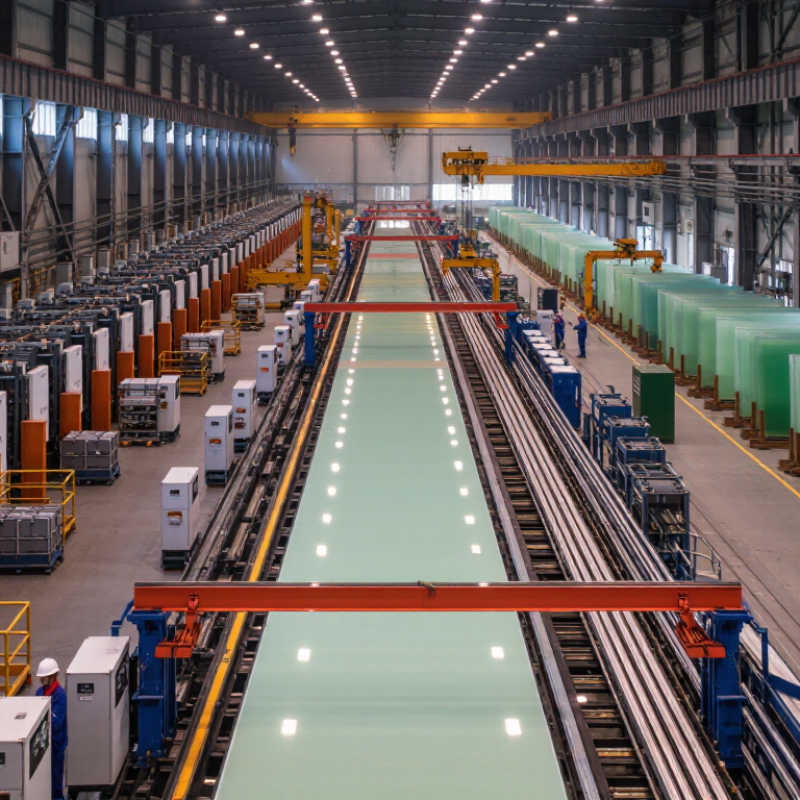
China’s float-glass industry is built around large, continuous production lines. A furnace runs day and night, drawing on steady supplies of silica sand, soda ash, fuel, and electricity. Scale matters. Plants tend to cluster near raw materials, transport routes, and construction markets, while high energy use and furnace costs make entry difficult.
The National Bureau of Statistics reported 969.01 million weight cases of flat glass output in 2023, down 3.9% year on year, in its Statistical Communiqué on the 2023 National Economic and Social Development. This figure covers flat glass, not float glass alone, so it should not be treated as a precise float-glass total. Still, it shows the scale of China’s broader flat-glass manufacturing base.
Industry structure is shaped by large producers, regional plants, and downstream processors that cut, coat, or temper glass for buildings, vehicles, and appliances. Demand can shift quickly with construction activity, leaving producers exposed to inventory and price swings. The picture is not perfectly tidy: public statistics group products differently, and regional capacity data can be hard to compare. For buyers, checking product specifications and delivery capacity matters as much as headline output.
Major Float Glass Manufacturers in China
Major Float Glass Manufacturers in China
China’s major float glass manufacturers serve construction, automotive, and interior markets. Their factories melt raw materials continuously, then form molten glass into flat sheets on a bath of liquid tin. Large production lines can supply substantial volumes, but scale alone does not guarantee consistent quality. It matters.
When comparing manufacturers, buyers should examine thickness options, sheet dimensions, optical distortion, and coating capabilities. Ask for current product data and inspection records, not just a capacity figure. A clear sheet should show no obvious waves or inclusions under suitable lighting. These checks are practical, though results can vary with the product grade and inspection method.
Manufacturing strength also depends on dependable furnace operation, process control, and delivery planning. Some producers offer a broad range of glass products, while others focus on particular thicknesses or downstream processing. That distinction is easy to miss. A useful supplier review considers samples, tolerances, packaging, and the distance between the plant and the destination. Capacity figures alone can mislead; they do not show how reliably a factory can meet a specific order. Buyers should verify details directly, since specifications and available products may change.
Who Are the Top Float Glass Manufacturers in China? - Major Float Glass Manufacturers in China
Company names are omitted. The table compares common profiles of major float-glass producers in China; it is not a company-by-company ranking, and the profiles are not assigned to specific manufacturers.
| Producer profile | Typical footprint | Common product range | Capabilities to compare | Typical markets served |
| Large integrated producers | Multiple production bases serving regional and national customers | Clear soda-lime float glass, with some producers also offering coated or processed glass | Number of operating lines, furnace capacity, product consistency, and delivery coverage | Construction, architectural glazing, and glass-processing customers |
| Regional float-glass producers | Concentrated around local manufacturing and construction markets | Standard clear and tinted float glass in commonly traded thicknesses | Local availability, order flexibility, lead time, and transport cost | Regional distributors, fabricators, and building projects |
| Specialty-glass-focused producers | Production and processing operations serving specialized customer requirements | Selected products such as low-iron glass, solar glass, or glass intended for coating and further processing | Optical quality, thickness tolerance, surface quality, and product-specific certifications | Solar, high-performance building, and other specialist applications |
| Producers with downstream processing | Float production linked with coating, tempering, laminating, or other fabrication services | Base float glass and selected value-added glass products | Processing range, finished-product quality controls, and ability to supply project specifications | Façade contractors, window manufacturers, and glass fabricators |
Buyer note: Float glass is formed by floating molten glass on a bath of molten tin. Compare suppliers using current specifications, independently verified production capacity, quality documentation, delivery terms, and the suitability of the exact glass type for its intended application.
Company Profiles: Products, Capacity, and Markets
China’s leading float glass manufacturers are best compared by product mix, furnace scale, and delivery reach. Large producers typically make clear, tinted, reflective, and coated glass for construction. Some also supply ultra-clear glass for façades and furniture. Their lines may run continuously, so stable furnace output matters as much as headline capacity. A plant’s daily tonnage is useful, but published figures can differ by site and product thickness. Check whether capacity means installed output or current production.
Company profiles should also show how glass reaches customers. Coastal plants may serve export markets through nearby ports, while inland facilities often focus on regional construction demand. Buyers should look for stated thickness ranges, processing options, quality controls, and transport limits. A 6-millimeter sheet behaves differently from a thin panel during handling. Small details matter. Public data does not always reveal downtime, yield, or actual utilization, so rankings deserve caution.
Tips: Request recent capacity figures and a product specification sheet. Confirm packaging, edge protection, and lead times before comparing quotes. One caveat: the cheapest offer may not reflect breakage risk or delivery consistency.
Comparing Manufacturers by Technology and Market Reach
Comparing Chinese float glass manufacturers by technology and market reach means looking beyond production volume. A stable float line can help control thickness, flatness, and visible defects across large batches. Buyers can ask for inspection records, sample specifications, and details about furnace maintenance. These provide more useful evidence than broad claims about advanced production. Small variations matter. A pane intended for a façade may need different optical consistency from one used in interior partitions.
Market reach is not just export volume. It also depends on whether a supplier can protect glass during shipping, coordinate container loading, and respond when an order changes. Manufacturers serving distant markets may have stronger logistics networks, while regional producers can sometimes offer shorter delivery routes. Neither advantage guarantees better quality. Not always. Compare the same product type, thickness, tolerances, and delivery terms before drawing conclusions. Public information may be incomplete, and a polished factory tour cannot replace repeatable test results. Even this comparison has limits: performance can vary between production runs.
Who Are the Top Float Glass Manufacturers in China? — Comparing Manufacturers by Technology and Market Reach
Industry context: the float process is a foundation of modern flat-glass manufacturing. The chart shows two historical milestones, not a ranking of Chinese manufacturers.
How to compare manufacturers: Look at production technology, product range, quality consistency, and the markets they serve. Float glass is widely used in construction, vehicles, solar panels, and appliances. Comparable, independently verified manufacturer-level data is not provided here, so no company names, market shares, or rankings are shown.
