
Contract Manufacturing for Injection Molded Plastic Products in North America
(800) 824.0607
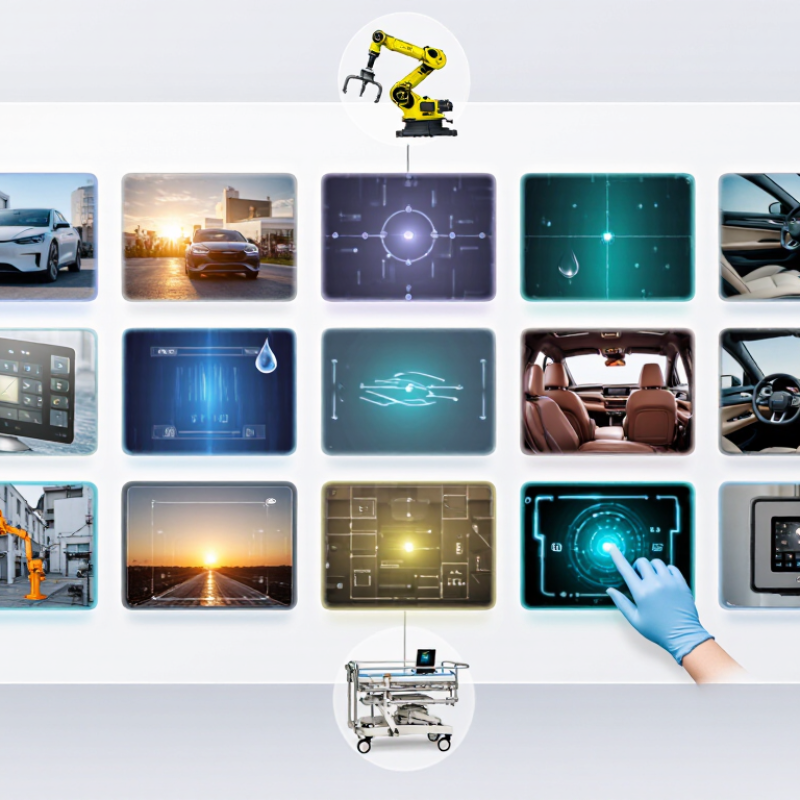
Projected capacitive touch displays are now common in vehicle dashboards, factory controls, kiosks, and medical equipment. Buyers comparing Pcap Touch suppliers need more than a bright screen. They need dependable performance in the conditions where people actually use it: with gloves, near water, under sunlight, or across long operating shifts.
Two recent reports help explain the demand context. The International Federation of Robotics’ World Robotics 2024 reported 4.28 million industrial robots operating worldwide in 2023. The International Energy Agency’s Global EV Outlook 2024 reported nearly 14 million electric car sales that year. These figures do not measure touch-panel sales. They do show expanding technology environments where responsive interfaces may matter.
Not every panel suits every application. A kiosk may need a durable cover lens and reliable operation in public spaces. A factory control panel may require glove compatibility, stable touch accuracy, and a wide operating-temperature range. Small details count. Optical bonding, controller tuning, interface options, and customization can affect the finished product. So can lead times and regional technical support.
This guide introduces ten PCAP touch-screen manufacturers for global buyers. It considers product range, integration capabilities, application experience, and support—not just headline specifications. Buyers should verify current data sheets and test samples against their own requirements. No shortlist can replace that work. Supplier claims also deserve scrutiny; published specifications may not reflect performance in a real installation. That gap is worth checking before a purchase decision.
Projected capacitive (PCAP) screens use mutual-capacitance sensing across a grid of transmitting and receiving electrodes. A finger changes the electrical coupling at nearby intersections, and the controller converts those changes into touch coordinates. Because the sensing layer sits behind glass, the front surface can remain smooth and easy to clean. This suits kiosks and control panels, where fingerprints gather around frequently used buttons. Real use varies. Check the edges.
Many PCAP controllers support up to 10 simultaneous touch points, enabling gestures such as pinch-to-zoom or two-handed input. However, ten-point support is a system capability, not a promise of equal accuracy in every installation. Thick cover glass, electrical noise, moisture, or poorly tuned firmware can affect tracking and edge response. Ask suppliers for tested cover-glass thickness, controller specifications, and performance data under intended conditions. Test with the actual enclosure, cables, and users; a bench demonstration can look reassuring, perhaps too reassuring. Gloves and water-rejection settings may also trade sensitivity for stability.
Mutual-capacitance sensing can track multiple simultaneous contacts. This chart illustrates the touch-point capability scale from one to ten; actual support depends on the touch controller and device specification.
Comparing ten global PCAP touch screen manufacturers works best when every supplier answers the same five questions: touch performance, display integration, durability, customization, and support. Start with the intended use. A kiosk in a bright lobby needs different optical performance from a compact control panel used with gloves. Ask for measured touch response, cover-glass options, and compatibility details—not just a claim of “high sensitivity.” Small differences matter.
For durability, compare rated operating conditions, surface treatments, and documented test methods. Request sample units and test them with the actual display, enclosure, and input conditions. A specification sheet cannot reveal every issue. Watch for false touches near water, inconsistent response at the edges, or reflections under overhead lighting. For customization, check whether the manufacturer can explain controller choices, mechanical tolerances, and revision control. Clear engineering answers are more useful than a long options list.
The fifth criterion is dependable delivery and support. Compare stated lead times, quality records, traceability, warranty terms, and access to technical staff. Ask how defects are investigated and how design changes are communicated. Then score all ten candidates against identical requirements, using evidence rather than brochure language. A tidy scorecard can still oversimplify things; one supplier may excel technically but struggle with communication. That trade-off deserves a note, not a convenient excuse.
For global buyers, comparing ten leading PCAP touch-screen manufacturers means looking beyond screen size. Product ranges commonly include glass-to-glass sensors, open-frame displays, bonded modules, and custom cover glass. Check supported touch points, controller options, and performance with gloves or moisture. Small details matter.
Grand View Research’s 2024 Touch Screen Market report estimated the global market at about US$6.5 billion in 2023, with a projected 13.6% compound annual growth rate from 2024 to 2030. This broad market estimate is not PCAP-only, but it signals expanding demand across industrial, retail, and consumer applications. Not every supplier serves each segment equally.
Regional coverage varies. Some manufacturers combine East Asian production with sales offices in North America and Europe; others rely on distributors for service in Southeast Asia or the Middle East. Ask where tooling, testing, and replacement units are handled. A nearby sales contact is not proof of local technical support. The awkward part: published coverage maps rarely show spare-part lead times. Request a sample, confirm environmental test conditions, and compare warranty response times before choosing a supplier.
This market overview uses anonymized supplier categories rather than company or brand names. Product formats and regional footprints are representative of the PCAP touch-screen supply market; they are not verified company-specific specifications or a ranked list.
| Supplier category | Typical PCAP products | Common size range | Typical applications | Regional market coverage |
|---|---|---|---|---|
| Small-format touch module suppliers | Projected-capacitive sensor panels, cover glass, and touch-controller assemblies | Typically under 10 inches | Handheld terminals, compact instruments, and embedded controls | East Asia manufacturing supply; customers and distribution channels worldwide |
| Mid-size touch-panel specialists | PCAP sensor panels and bonded touch-display assemblies | Approximately 7–15 inches | POS terminals, medical instruments, and control panels | Asia-Pacific production with sales into North America, Europe, and other regions |
| Industrial HMI display suppliers | PCAP touch monitors, open-frame displays, and panel-mount assemblies | Typically 7–24 inches | Factory automation, machine interfaces, and process-control equipment | Global industrial markets, commonly served through regional integrators and distributors |
| Rugged and outdoor display suppliers | PCAP displays with enhanced cover glass and systems designed for demanding environments | Commonly 10–32 inches | Outdoor kiosks, transport terminals, and industrial equipment | North America, Europe, and Asia-Pacific demand; availability varies by configuration |
| Large-format interactive display suppliers | Large PCAP touch panels and integrated interactive displays | Typically 24 inches and above | Interactive signage, collaboration systems, and public information displays | Worldwide project markets, often supplied through system integrators |
| Custom cover-glass and sensor fabricators | Custom-shaped PCAP sensors, printed cover lenses, and optical bonding | Application-dependent; small to large formats | Special-purpose equipment, branded interfaces, and product-specific designs | Primarily project-based supply across Asia-Pacific, Europe, and North America |
| Touch-controller and integration specialists | PCAP controller boards, firmware tuning, and sensor integration services | Depends on the sensor and display design | Embedded systems requiring customized touch performance | International OEM supply chains, with engineering support often provided regionally |
| Medical and clean-environment display suppliers | PCAP touch displays and sealed front-panel assemblies | Commonly 10–24 inches | Clinical equipment, laboratory systems, and cleanroom interfaces | North America, Europe, and Asia-Pacific medical technology markets |
| POS and self-service terminal suppliers | PCAP touch monitors, kiosk displays, and terminal-ready assemblies | Typically 10–22 inches | Retail checkout, ticketing, ordering, and self-service kiosks | Global retail and transport deployments, commonly supported by local integrators |
| Embedded-display module suppliers | PCAP touch-screen modules combining a display, sensor, and interface components | Commonly 3.5–15 inches | IoT devices, instruments, and embedded control products | Broad international OEM supply, with strong sourcing networks in Asia-Pacific |
Note: Size ranges and regional coverage are indicative market characteristics, not guaranteed specifications or a statement of any individual supplier’s sales territory.
PCAP selection starts with the interaction, not the largest touch-point number. Ten-point sensing suits simultaneous gestures, while kiosks or control panels may need only one or two points. More points can increase controller and software demands.
Test with gloves, moisture, and electrical noise present. Real conditions matter.
Cover glass affects both durability and touch response. Thicker glass may require controller tuning; anti-glare finishes can soften image clarity. Specify glass thickness, edge treatment, and optical bonding early.
Panel size also changes the design: a 7-inch handheld display and a 21.5-inch public terminal need different sensor layouts and tuning. There is no universal best.
Fortune Business Insights’ touchscreen-market report valued the global market at USD 76.73 billion in 2023 and projected USD 166.12 billion by 2032. That broad market figure signals scale, but it does not define a suitable PCAP specification.
Keep touch and display interfaces distinct. USB is common for external touch controllers; I²C often suits embedded systems. HDMI or eDP carries display video, not touch data.
Confirm connector pinout, controller support, cable length, and operating-system compatibility with the manufacturer. A neat datasheet is not enough.
Prototype the complete stack, especially when cover glass, bonding, and a large panel are combined.
For global buyers comparing PCAP touch screen manufacturers, ESD qualification deserves more than a line in a datasheet. IEC 61000-4-2:2008, Table 1, sets Level 4 at 8 kV contact discharge and 15 kV air discharge. These are test levels, not a guarantee that every installed screen will behave identically. Enclosure materials, grounding, cable routing, and the controller configuration can all affect the result.
Small details matter.
Ask manufacturers for test reports tied to the actual display assembly, not only a similar product family. Check the test level, discharge points, number of applications, and whether the screen recovered after exposure. Did touch input resume without a reboot? That detail is easy to overlook.
A clean laboratory result may not reflect a kiosk with a long cable, a painted metal frame, or a hurried installation. Buyers should also confirm whether tests covered both contact and air discharge, since one result cannot stand in for the other.
The paperwork can look complete and still leave gaps. Review those gaps before qualification, and record the exact configuration used for approval.