Why Is MBBR System Used for Wastewater Treatment?
Wastewater treatment plants must remove organic pollutants and, where required, reduce nitrogen within practical space and operating limits. A Mbbr System For Wastewater Treatment uses small carrier elements that move through an aerated tank. Microorganisms grow as a biofilm on their surfaces, while wastewater flows around them. The carriers add protected growth area without requiring a separate fixed-bed structure. That matters.
This arrangement can help facilities increase treatment capacity or upgrade an existing tank, depending on the wastewater and design. It can also support a steady biological population when flows or pollutant loads vary. But performance is not automatic. Carrier fill, aeration, mixing, screening, and process control all influence results. A poorly mixed tank may leave carriers unevenly distributed; excessive aeration can waste energy. Small details matter.
This article explains why engineers choose MBBR technology, how the moving biofilm supports treatment, and where the process fits among other biological options. It also considers practical limits, including maintenance needs and the importance of site-specific design. MBBR is not a cure-all. Its value depends on matching the system to the actual wastewater, discharge goals, and operating conditions. Real plants are less tidy than diagrams. That is worth remembering before selecting equipment or estimating performance.
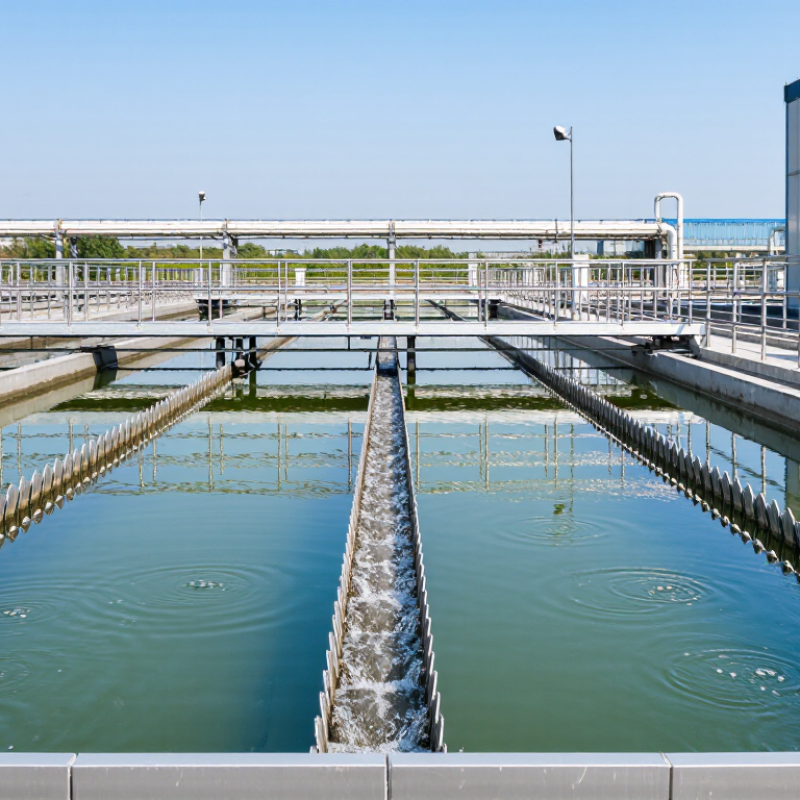
How Moving Biofilms on Carriers Break Down Wastewater Pollutants
In an MBBR, small carriers circulate through a tank while wastewater flows around them. A thin biofilm grows on each carrier, giving microorganisms a stable surface even as the water moves. The outer layer often consumes readily available organic matter; deeper zones can support slower-growing organisms, including nitrifiers that convert ammonia. Oxygen supplied by aeration helps these reactions, while mixing brings fresh wastewater to the film. The carriers do not “filter” pollutants like a screen. Microbes transform them.
The available surface is a practical advantage. McQuarrie and Boltz’s 2011 review in Water Environment Research reports protected carrier areas of roughly 350–1,200 square metres per cubic metre, depending on media design. More surface can support more biofilm in a compact tank, but it does not guarantee better treatment. The result still depends on temperature, oxygen, loading, and carrier movement. Watch the carriers in a real tank: uneven circulation or clogged screens can undermine performance. Small details matter. Operators also need to track ammonia and organic matter in the effluent; a clear-looking tank is not proof of complete treatment. Biofilms can vary, and design ranges should not be mistaken for a plant’s measured results.
Why Is an MBBR System Used for Wastewater Treatment?
Typical reported removal-efficiency ranges for moving-bed biofilm reactors (MBBRs)
MBBR carriers provide a protected surface for biofilms, where microorganisms break down biodegradable organic matter and convert ammonia. The bars show commonly reported ranges, not guaranteed results; performance depends on wastewater composition, temperature, loading, aeration, and operating conditions.
Carrier Media Provide Roughly 500–1,200 m² of Surface Area per m³
Moving bed biofilm reactors use small carriers that circulate through wastewater while microorganisms grow on their surfaces. Depending on their shape and measurement method, carrier media may provide roughly 500–1,200 m² of surface area per m³ of media. That is a large attachment area in a compact volume. It gives biofilms room to develop without relying only on suspended microbes.
The figure refers to the media itself, not necessarily each cubic metre of the whole reactor. A reactor’s usable biological area also depends on how much media it contains, how well it moves, and whether wastewater reaches its surfaces. In a working tank, carriers tumble and mix. You may see them bumping against screens near the outlet. Poor mixing can leave some areas less active, even when the stated surface area looks impressive.
The range is useful for early comparisons, but it is not a treatment guarantee. Different suppliers may report nominal or protected surface area, and those values are not always directly comparable. A careful design checks the wastewater load, temperature, oxygen supply, and carrier fill fraction together. More area is not automatically better. Too much media can restrict movement, while too little may limit biofilm capacity. Real operating data should guide final sizing.
Typical Media Fill Fractions of 30–60% Balance Biomass and Mixing
Why Is MBBR System Used for Wastewater Treatment?
Typical Media Fill Fractions of 30–60% Balance Biomass and Mixing
In a moving bed biofilm reactor, plastic carriers provide protected surfaces for microorganisms. A media fill fraction of 30–60% is common because it offers useful surface area while leaving room for movement. The exact level depends on carrier shape, tank geometry, and wastewater strength. More is not better.
At roughly 30%, carriers have space to circulate, and aeration can keep them moving through the tank. This movement helps bring wastewater and oxygen to the biofilm. At higher fractions, more carrier surface may support additional biomass, but crowded media can collide, move unevenly, or create poorly mixed zones. Operators can watch for carriers collecting near corners or moving in clumps.
A 60% fill is not automatically the right choice. Small-scale testing or operating data can help identify whether extra media improves treatment without disrupting circulation. Check dissolved oxygen, ammonia removal, and carrier movement together; one reading alone can mislead. The balance can be frustrating. Even a well-sized fill fraction may need adjustment when flow or organic loading changes. A practical design leaves enough clearance for mixing and maintenance, rather than treating the percentage as a fixed target.
Aerobic MBBR Design Commonly Targets Dissolved Oxygen Near 2 mg/L
In an aerobic moving bed biofilm reactor (MBBR), aeration has two jobs. It supplies oxygen and keeps the plastic carriers moving through the tank. A dissolved oxygen target near 2 mg/L is commonly used as a practical starting point. It can support aerobic treatment without automatically demanding excessive air. But it is not a universal setpoint.
The oxygen reading in the water does not show conditions throughout each biofilm. A thick film may have lower oxygen deeper inside, even when a probe reads close to 2 mg/L. Operators should check the reading under normal loading, not only during a quiet test. Watch for uneven carrier movement, rising ammonia, and changes in effluent quality. These clues can point to oxygen limits, though they may have other causes.
Small adjustments matter. Check the probe’s calibration and placement, then compare readings across the tank if mixing seems uneven. Cold water, peak flows, and higher organic loads can change oxygen demand. More air is not always the answer; it can increase energy use or disrupt a stable process. A target near 2 mg/L gives teams a useful reference, but site conditions deserve a closer look.
Staged MBBR Tanks Support BOD Removal and Ammonia Nitrification
Why Is MBBR System Used for Wastewater Treatment?
Staged MBBR Tanks Support BOD Removal and Ammonia Nitrification
Staged moving bed biofilm reactor (MBBR) tanks separate carbon removal from ammonia nitrification. In the first tank, biofilm on suspended plastic carriers consumes biodegradable organic matter, lowering BOD. The carriers move as air or mixers keep them circulating. This creates a practical buffer when incoming wastewater strength changes, though it does not remove the need for routine monitoring.
A downstream tank can favor slower-growing nitrifying bacteria by reducing competition from carbon-consuming microbes. The U.S. EPA’s Nutrient Control Design Manual (2010) reports that nitrification uses about 4.57 grams of oxygen and 7.14 grams of alkalinity, as CaCO₃, per gram of ammonia-nitrogen oxidized. Operators therefore track dissolved oxygen, pH, temperature, and alkalinity—not just ammonia readings. Cold water can slow nitrification. Staging helps, but it cannot compensate for inadequate aeration or insufficient alkalinity. That trade-off is easy to underestimate.
Tips: Check ammonia at both the tank outlet and final discharge. A sudden rise may point to low oxygen, cold conditions, or depleted alkalinity. Keep a simple trend log; one reading rarely tells the whole story.